
The state of the horse right now
What symbol and function does the horse embody in a world where the horse is at most a sporting animal. Why is the connection between the horse and the human so strong, although the most usual encounter is on a TV-screen or through a car window? I believe the horse can be a guiding creature to understand the state of the world and the people living in it.
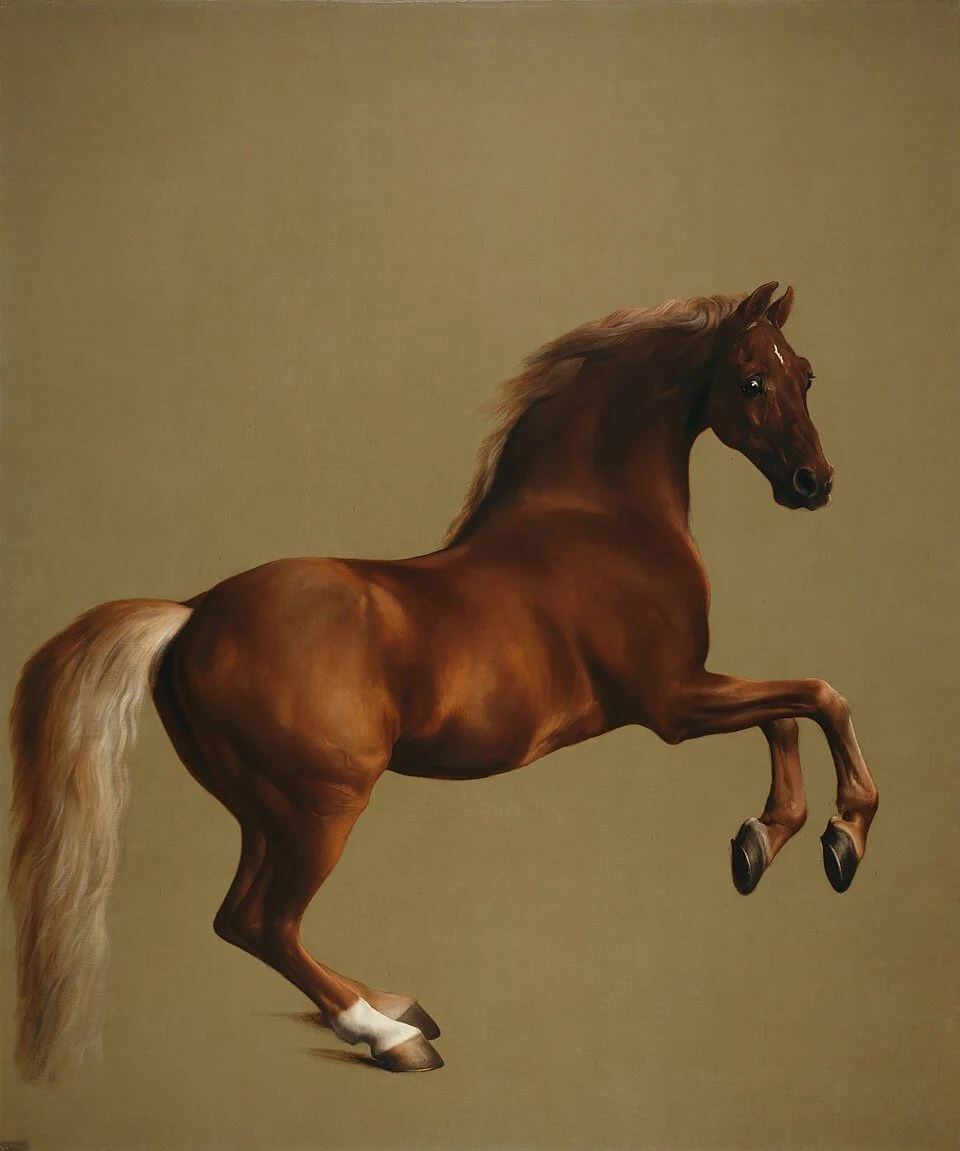
George Stubbs Whistlejacket (1762). Oil-on-canvas, 292 cm × 246.4 cm. © The National Gallery, London.
The painting Whistlejacket (1762) is George Stubbs´ depiction of the racehorse, Whistlejacket. The horse's head is turned towards the viewer while rising to a levade. But, the horse is painted without a rider or even a saddle. Whistlejacket is rather standing alone in front of a plain green/brown background, with a hint of a shadow behind its rear legs. It looks frightened, almost as if it knows that within the next 150 years the horse would be changed out by a machine, within transportation, the agricultural industry and the cultivation of land. During the 1920s the role of the horse was completely transformed, and the beast of burden has now mainly become a recreational and sporting animal.
The symbol of the contemporary horse is certainly not yet defined. Could it be running away from the rapidly evolving society and seeking shelter within the structures of a traditional lifestyle, like talking horse Mollie did in George Orwell's Animal Farm? Maybe it's just a horse, or rather a depiction of a further depiction of a horse, a simulacrum. That understanding of Whistlejacket has moved so much from the animal itself, that it has become something else, with roots in simply another depiction. Or is it a slave on a farm, working each and every day just to be sold to another farm, just like our information every year is being gathered and extracted by a company just to be sold to another company. Maybe the contemporary horse is a beacon of hope, because there is nothing more independent and free than a wild horse.
When trying to understand the state of the horse right now through depiction only, the creator of the narrative is certainly important to consider. When I look at the painting, I'm not just looking at Whistlejacket, but at Stubbs himself, and as a product of his time, his context. The artist can train, practice and align all they want but will never escape their context and timing. When working with the state of art in both knowledge and technology one will neither surpass or be behind the time one lives in. An artwork like Whistlejacket depicts more than just a horse. If we look closer, we might be able to uncover the state of not only the horse, but the contemporary world and how we've shaped it through our intuition.