
Where One Thing Ends and Another Begins
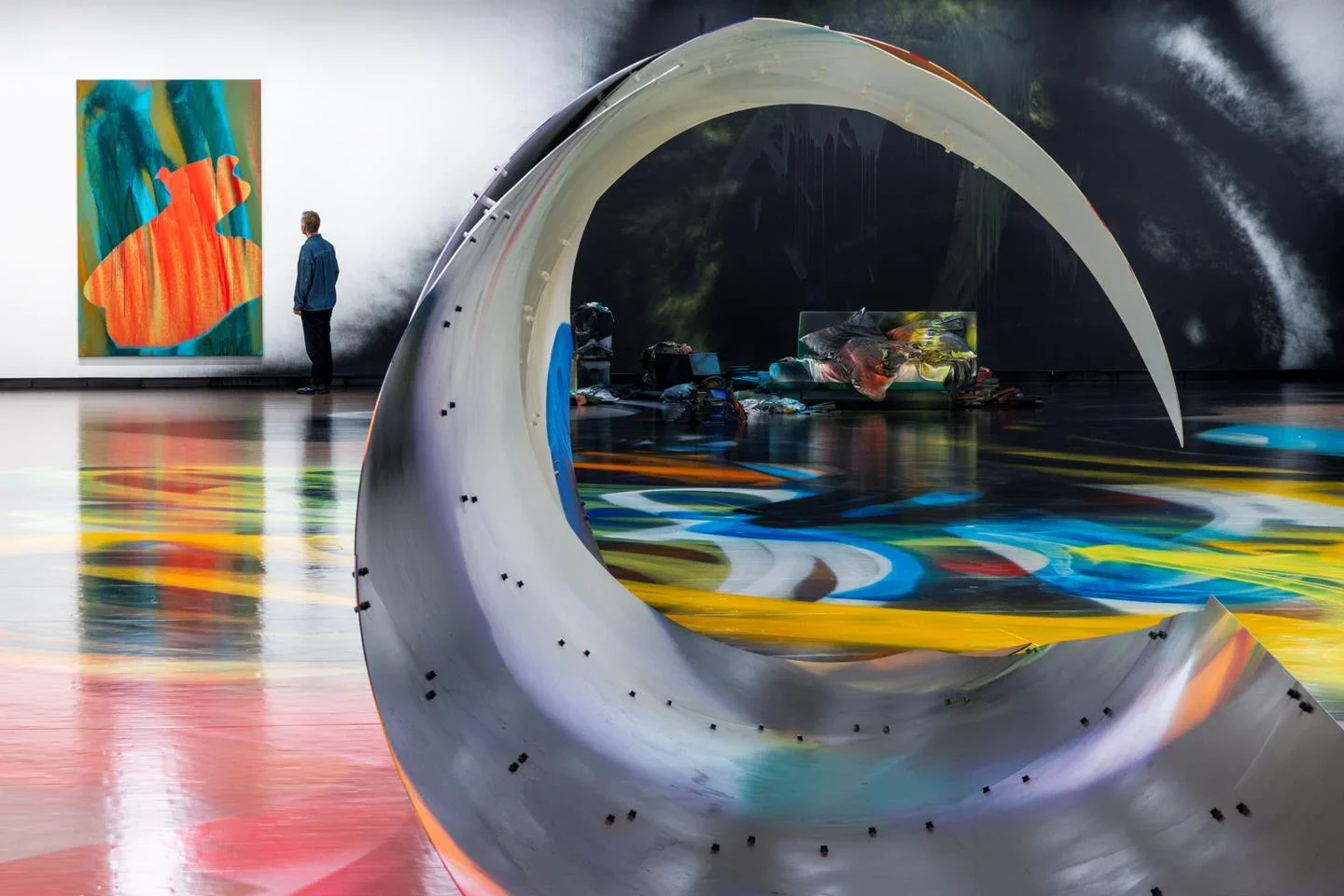
Photo: Ove Kvavik, Muchmuseet.
Katharina Grosse’s Black Bed at the Munch Museum is an exhibition that is difficult to experience from a distance. Created in dialogue with Edvard Munch and his artistic legacy, Grosse’s works repeatedly draw the viewer closer before pushing them away again. Monumental paintings confront us with their scale, while smaller works require us to approach; familiar objects become strange; playful colours become oppressive; and paint escapes the canvas to spread across the architecture of the museum. The exhibition consequently creates an unstable relationship between the viewer and the artwork, in which the boundaries between looking and experiencing, painting and environment, are constantly shifting.
The character of Grosse’s work is often described as challenging traditional painting and the viewer’s perception and experience. However, within this challenge, there is a recurring theme of contradiction that fuels the disturbance - at all times, a confrontation between two variables. Monumental works are placed alongside smaller paintings on paper; closeness is constantly interrupted by distance; the abstract meets the concrete, the mathematical meets the intuitive and the organic meets the inorganic. The exhibition never seems to settle on one side of these oppositions. Instead, it is precisely the movement between them that produces its character.
The first room we enter feels monumental, however somewhat ordinary. Several large paintings occupy a single room, conforming at first to a familiar exhibition format. It feels like an introduction to the exhibition, allowing the viewer to become acquainted with its atmosphere.
The paintings, most of them untitled, are abstract, but varied both in size and form. The use of spray paint provides a softness to the works, while the sharpness of brushstrokes disturbs it. There is something light and almost happy in the colours and movement of the paintings, but this lightness is never entirely comfortable. They seem to flow freely across the surfaces, while at the same time being interrupted by lines, shapes and abrupt changes in colour. Even where they initially appear open and playful, there is an obstacle within the flow.
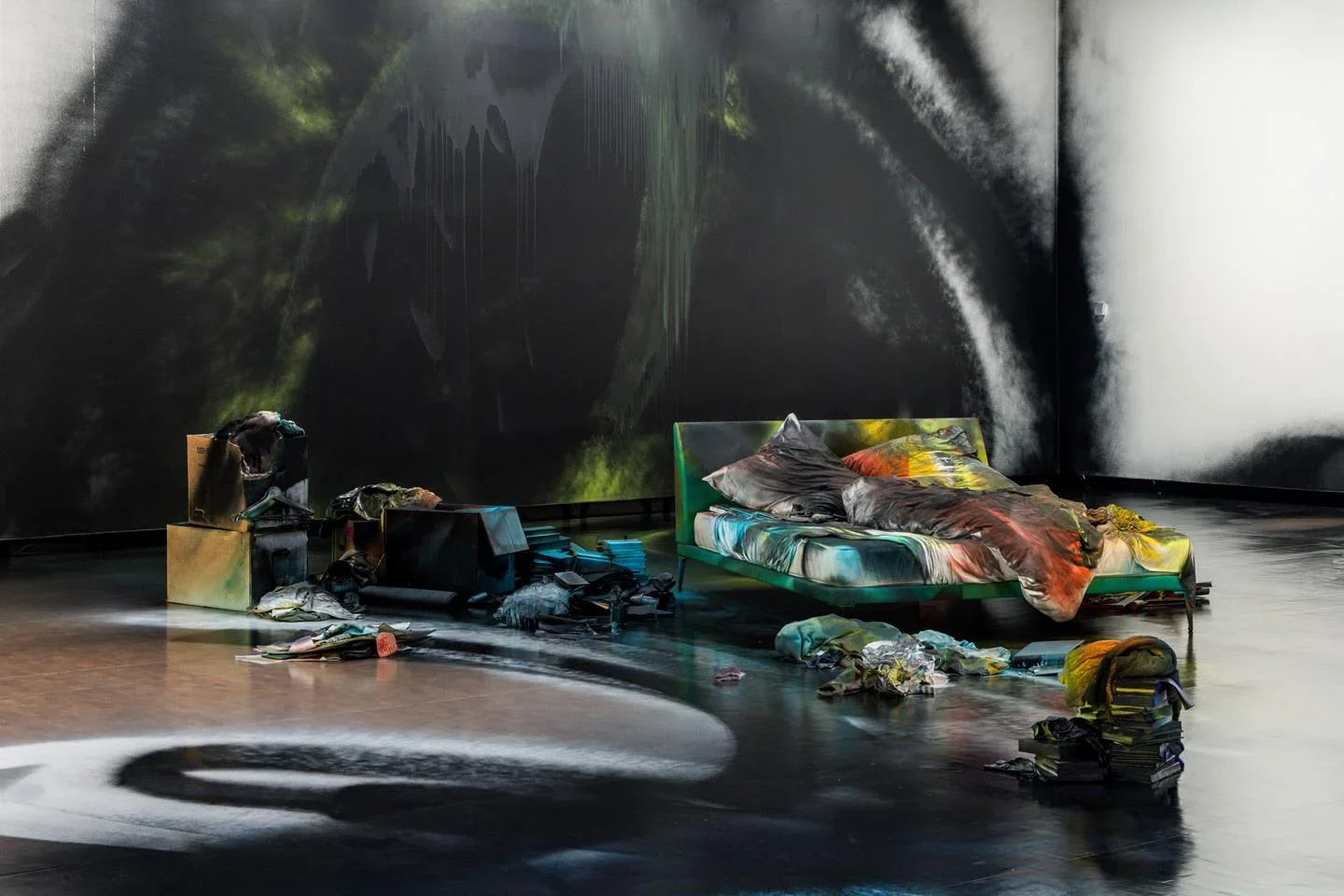
Photo: Ove Kvavik, Munchmuseet.
The second room opens up with a bed. This is a newly produced installation that recreates one of Grosse’s key works, Das Bett from 2004. Here, the artist’s bedroom, including furniture, clothes, and belongings, has been spray-painted and ultimately destroyed in the process.
My immediate experience is one of dread, fueled by the shift from the lightness of the first room. The bed is such a familiar object that requires little explanation, while the sudden use of dark colours produces a heaviness and unsettlement. Reminiscent of mold spreading all over the belongings, the walls and the floor, I get a feeling that I need to get out. The work is no longer something I simply look at. It becomes something I physically respond to.
This transformation of the familiar into something strange is important throughout the exhibition. The bed is concrete and familiar: it is an object with an obvious function, one associated with sleep and privacy. However, it also carries something of the subconscious with it. A bed is where we sleep and dream, where the boundary between the conscious and unconscious becomes blurred. By covering the bed and the surrounding belongings in paint, Grosse seems to transform this intimate, recognizable space into something closer to a dream or, better yet, a nightmare. The cerebral is therefore not represented through an image, but through an actual environment that the viewers enter. The paint is therefore both constructive and destructive. It creates a new environment while simultaneously destroying the identity of the objects underneath it. The bed remains recognisable, but its previous familiarity has been made inaccessible.
Being guided by the spreading paint on the varnished floor, the room then opens up to a huge space dominated by a metal installation in the middle, along with several paintings - both monumental, and smaller paintings on paper. The paintings on paper are installed on the walls without frames, which makes for an unfinished feeling, but one that also brings the viewer closer to the artwork. With paint spread over parts of the walls as well as the whole floor, it feels like entering the artist’s studio space.
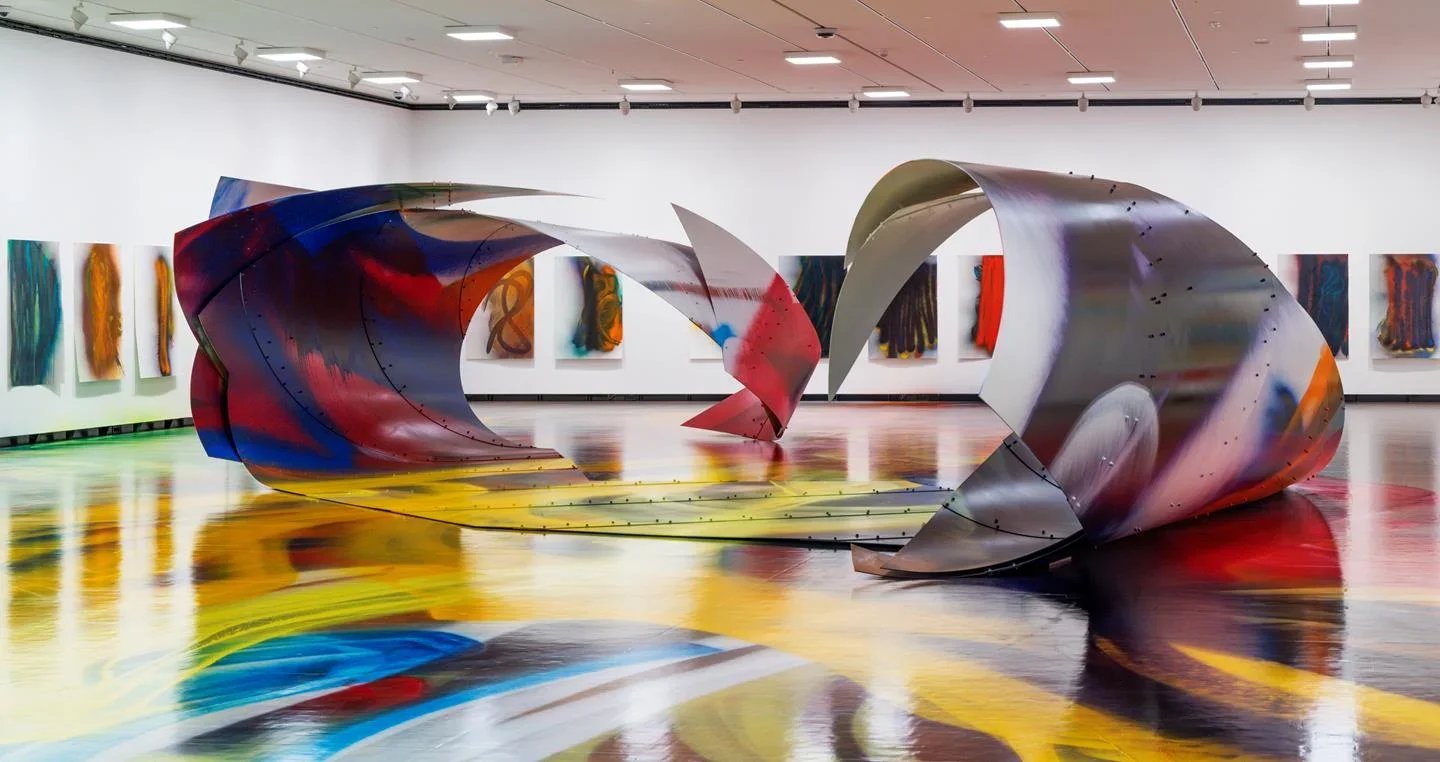
Photo: Ove Kvavik, Munchmuseet.
Yet there is a constant shift between feeling embodied and close to the artwork, even feeling like part of it, and feeling distant, like an observer. The painted floor leading the viewer through the space does not merely create guiding lines, but also includes us as part of the artwork. Shifting where we stand also shifts the appearance of the art. The work therefore cannot be experienced from one fixed position. It changes with the body.
At the same time, the varnish makes the floor more reflective and strangely institutional. This makes us unsure of where the artwork begins and ends, and even whether what we are looking at was made by the artist or was already part of the museum. The museum therefore stops functioning as a neutral container and becomes part of the experience of the artwork. Yet this also makes the institution more visible - the same surface that brings us into the work reminds us that we are still in a museum, looking at something designated as art. This tension between immersion and distance also appears in the contrast between the monumental paintings and the smaller works on paper. The monumental works demand space and confront the viewer with their scale. The works on paper, by comparison, require us to move closer. Their size makes them intimate, almost vulnerable, while their unframed presentation makes them appear unfinished or provisional. They seem less like autonomous objects and more like traces of a process.
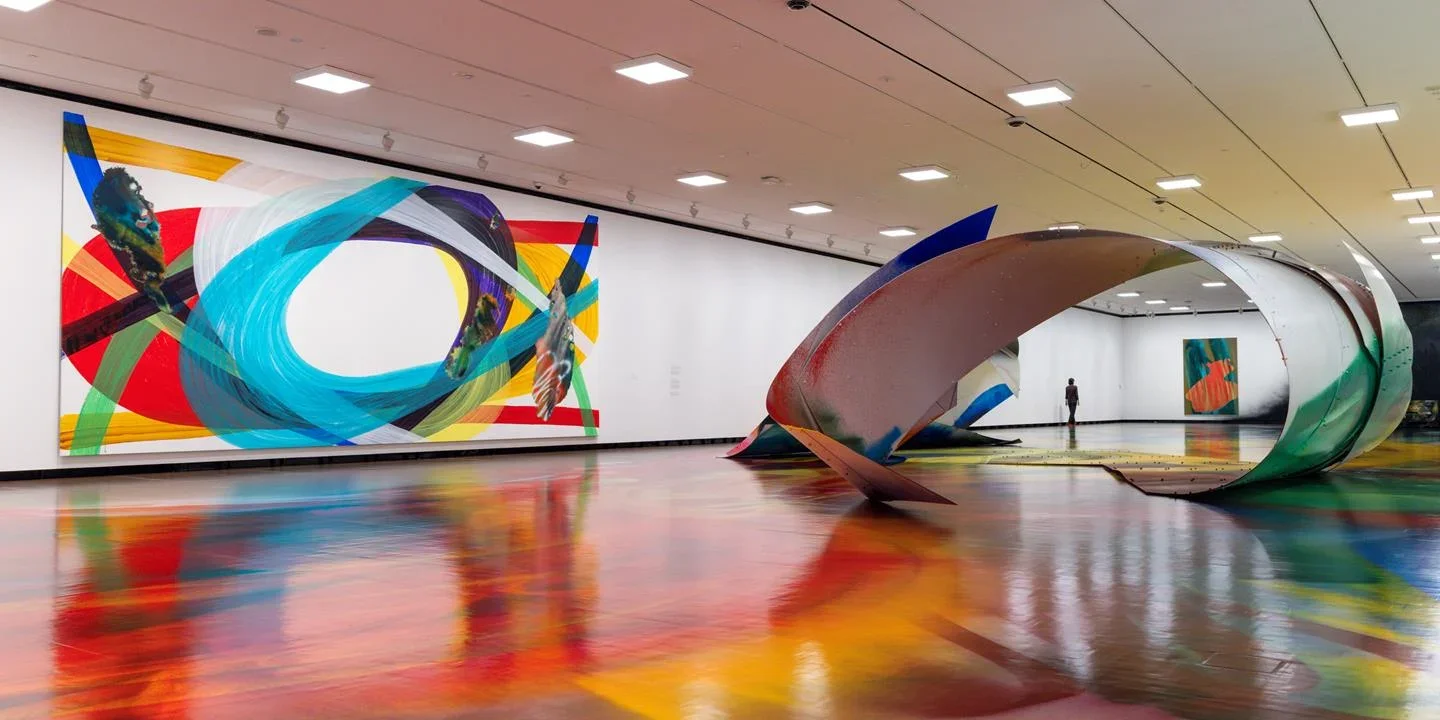
Photo: Ove Kvavik, Munchmuseet.
The metal installation in the centre of the room introduces another version of this contradiction. Unlike the bed, it does not immediately expose its origins or function. The bed is familiar and intimate; the metal structure is unfamiliar and resistant. One carries the associations of the home, the body and sleep, while the other appears almost mathematical or industrial. Yet both have been transformed by Grosse into something that feels psychologically charged.
The contrast between the organic and the inorganic becomes particularly visible in the way Grosse creates her marks. In some of the monumental paintings, branches have been used almost as stamps, leaving behind traces of their organic structures. Yet once transferred onto the canvas, the branch is no longer primarily experienced as a branch. Its shape becomes a line, a pattern, a network of forms. Something recognizable is transformed into something abstract.
Here, the mathematical and the intuitive meet. The works can appear spontaneous, as if the paint has simply been allowed to move and spread according to its own logic. At the same time, there is a strong sense of structure in the lines, shapes and repetitions. The works appear intuitive, but never truly uncontrolled - beneath the apparent spontaneity is a strong sense of structure.
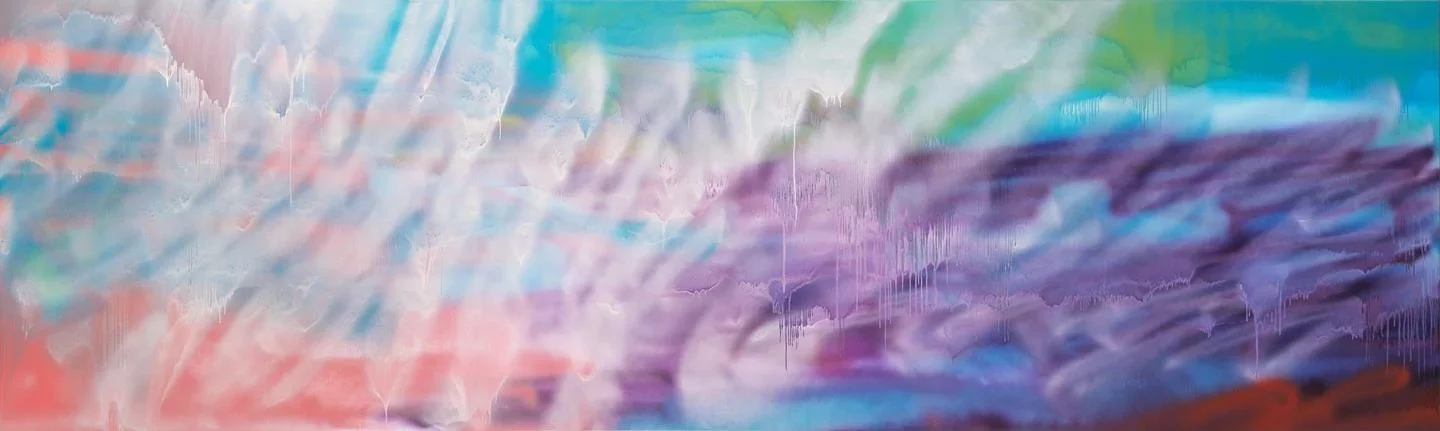
Katharine Grosse, Uten tittel, 2004. Akrylmaling på lerret, 270 × 900 cm. ©VG Bild-Kunst Bonn, 2025
The exhibition becomes a constant movement between the dream and the embodied experience of being physically present. The bed brings us into a familiar and intimate world before the exhibition releases us into a more abstract environment. But the dream is never detached from the body. We have to walk through it, encounter obstacles, follow lines, shift our position and see the works change with us. Grosse’s dialogue with Munch therefore becomes less about reproducing his imagery than about translating a psychological experience into physical space. Where Munch often gives inner states a recognisable human or natural form, Grosse removes much of that familiarity and makes the viewer inhabit the instability instead.
The disturbance lies here. Grosse opens painting up, making it spatial and accessible, while simultaneously placing it firmly within the institution of the museum. The first room retains something of the traditional exhibition with paintings on the wall and the viewer standing at a distance. The second room gradually breaks down this arrangement. Paint leaves the canvas, spreads onto the walls and floor, surrounds the viewer and changes the space itself. At times, however, this expansion risks becoming a spectacle - when everything becomes part of the artwork, the distinction between meaningful disruption and visual excess becomes less certain. Yet this tension is also central to the exhibition, since the museum never completely disappears as a space of looking.
What initially appears to be a progression from one room to another is therefore also a movement between different ways of experiencing art. The familiar becomes strange; the abstract becomes physical; the monumental becomes intimate; and what initially feels light and playful can suddenly become threatening. Grosse does not offer a stable opposition between two things, but continuously makes one become the other. Her disturbance lies not simply in breaking down the boundaries of traditional painting, but in making us unsure of where one thing ends and another begins.