
Party at the Castle: Troye Sivan and the queer origins of Gothicism
‘The conquest is nearly behind us… at long last… a party.’
With the gravitas of the grey wizard, Sir Ian McKellen opens the music video for Troye Sivan’s new song ‘Party’, beckoning his followers into a medieval world of hedonistic revelry. Regarding the inspiration for the video, Troye told Esquire,
“Surely people have always partied, so what did it look like in the past? We went back in time and through [sic] the most debaucherous party that we could possibly imagine.”[1]
Perhaps, a viewer might think that the raw queer sexuality is a stark juxtaposition to the calm of the English country seat. They would be wrong. The video dances through a pre-Raphaelite romantic sense of the medieval to a ballroom beat. It moves us from the violent, muddy medieval of a Netflix-style epic, towards the more ethereal visual codes of Saltburn.
With the eruption of the field of ‘queer’ history, countless popular history books claim proof that from Sappho to Wilde, ‘We have always been here’.[2] The historical world that Troye deals with is more abstract, it is the historical imagination. It is the inheritance of the Gothic, a memory of the medieval, Catholic imagery, and fantasy. For him, the Gothic is a visual rhetorical tool, fighting battle against the rising tide of a clean-girl, coffee-rave-run fuelled sterilized modernity. He wages war against the cultural forces that seek to snatch Cinderella’s pumps and leave her with office appropriate flats.
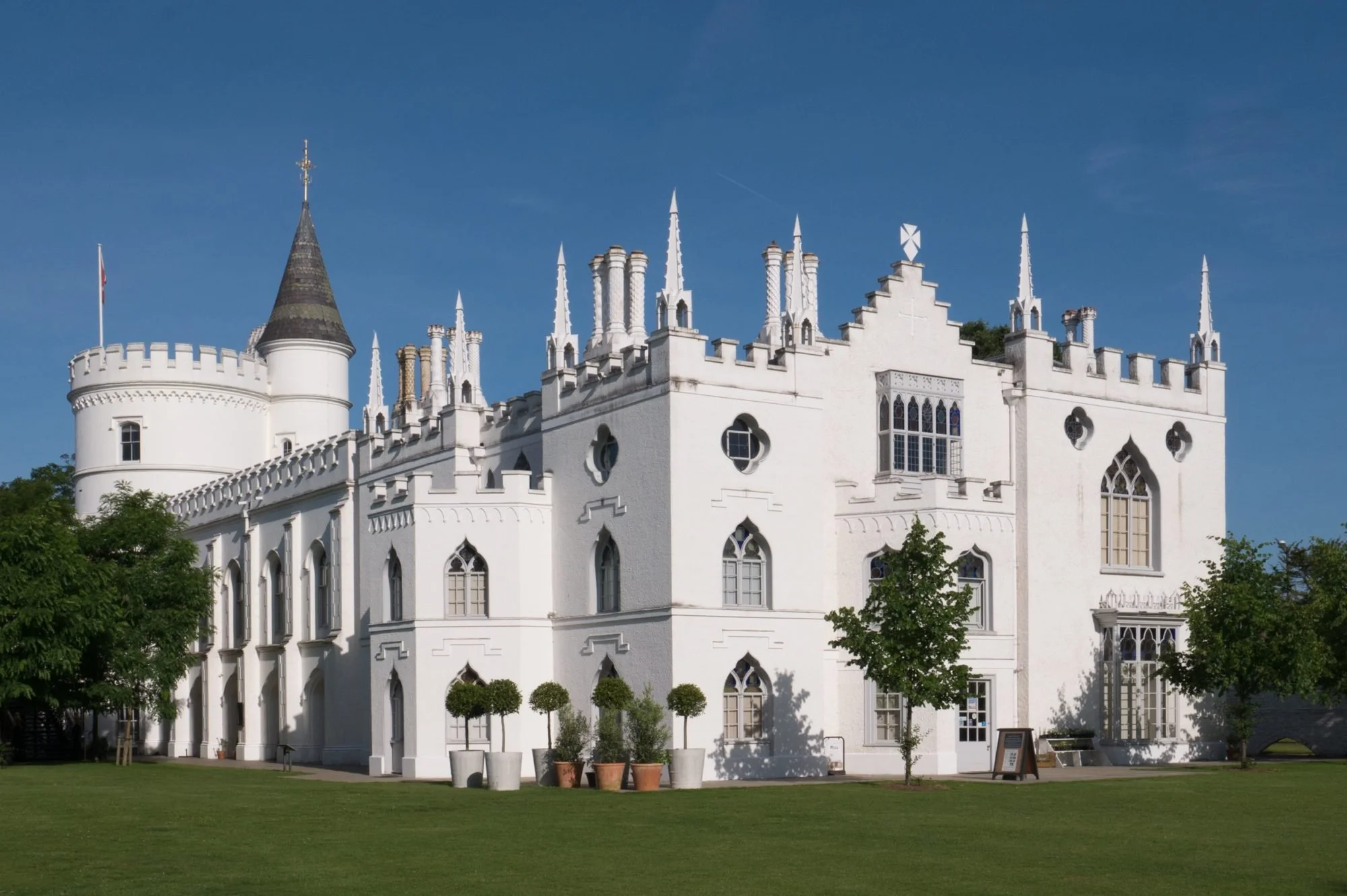
Horace Walpole, Strawberry Hill House (1749–1776).Twickenham, London. Image source: O’Sullivan / Strawberry Hill House & Garden.
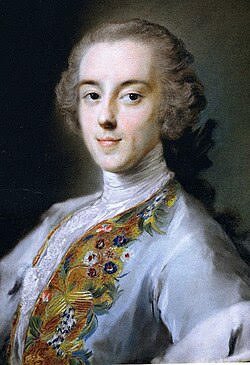
Rosalba Carriera, Horace Walpole (1741). Pastel on paper, 61 x 46.5 cm. Haughton Hall, Norfolk. Image source: Wikimedia Commons.
When invited to a ‘party in my house’, one hopes the house in question is Strawberry Hill. This mid-eighteenth-century masterpiece lies on the banks of the Thames, a decadent labour of love by the very instigator of the Gothic Revival, Horace Walpole. It was Walpole, renowned for his cross-dressing flair at masquerade balls and friend group of limp-wristed ‘finger-twirlers’, who authored the first work of Gothic literature.[3] He commissioned Strawberry Hill House, with its thrusting spires and looming medievalesque turrets as a citadel to fortify the whimsical world he constructed with his friends. Within this palace of impropriety, his Uranian circle of men, women, and whatever else could rebel against the contemporary regime of Palladian masculinity that demanded a humble simplicity. Historian Matthew Reeve explains how as concepts of identity and consumerism emerged in this period, this countercultural aesthetic style was forged as a coded practice amongst these circles to reject rising notions of unadorned male propriety.[4] The Gothic became a looking glass through which one could step through to a realm of expanded possibilities, a physical space where social norms were altered through art. Thus, as the beautiful male was slain in the Great Masculine Renunciation, his banner was carried forth by Arthurian dandies.[5]
Gothic aesthetics have since served queer people as a stylistic sword against the rigid, neoclassical regime of conformity and modesty. But with Chappell Roan as Joan of Arc at the VMAs, Kit Connor and Manu Rios as medieval monks in an upcoming queer body horror, and Troye showing heraldic hole, why have gothic aesthetics regained their popularity amongst queer people?[6]
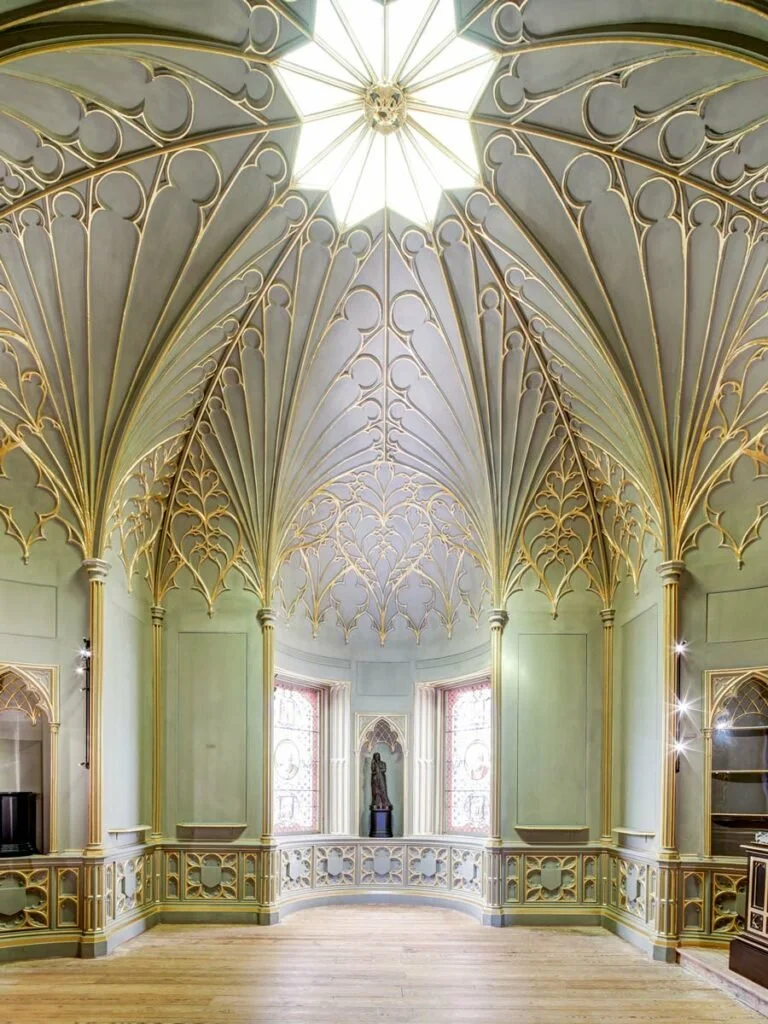
Horace Walpole, interior of Strawberry Hill House (1749–1776).Twickenham, London. Image source: Matt Chung / Strawberry Hill House & Garden.
Medieval references have been especially relevant during times of upheaval and cultural pessimism. The industrial revolution, most pronounced in Great Britain, led to the birth of the Arts and Crafts movement, the pre-Raphaelites, and a century of architecture invoking tales of Scottish lairds and Welsh princes, memorialising the ancient past as factories polluted the present. In our own dawning age of industrial revolution, the AI barons cast a dark cloud over the future as legions of data centres encroach upon our shires. Where modern institutions like the UN falter in the face of such threats, great swathes of society now look ‘back’ to another proponent of medieval iconography, the Catholic Church. Yes, that great patron of the queer arts is being rediscovered in a new light.[7]
An unlikely alliance, perhaps. The sensual sexuality of ‘Party’ may be seen as antithetical to papal propriety. Yet the queer goth and men of the cloth share a common idea. To reject the ‘rational’ machine, in favour of a more enchanting vision of love, be it humanist or spiritual. Across society, we hark back to a comforting, enduring sense of the past. History is not the story of what happened in said past, but our engagement with its memory. When we partake in its art and aesthetics, we claim a stake in its cultural legacy, be it polyester-clad hard-right ‘crusaders’ in England, or Troye in Jacobean dress.[8] As narratives of the medieval are contested in the public sphere, we must not let this tradition vanish, our heritage, from Walpole to Woolf, of a misty past as a place to play with identities. The Gothic, as a reinterpretation of the medieval, has always been the home of the queer, a decorative form of excessive ornamentation to reimagine ourselves beyond the norms of the present.
References
[1] He, Sirena. 2026. “Troye Sivan Knows How to Throw a Party.” Esquire, September 29, 2026.
[2] De Cosio, Federico. 2026. We Have Always Been Here: 242: LGBTQ+ Lives Across 5,000 Years. Zenodo.
[3] Conway, Henry Seymour. (1737) 1973. “From Conway, 25 January 1737 OS.” In Horace Walpole’s Correspondence, edited by W. S. Lewis, vol. 35, 2. Oxford: Oxford University Press.
Lynch Piozzi, Hester. (1784-1809) 1942. Thraliana: The Diary of Mrs. Hester Lynch Thrale (Later Mrs. Piozzi) 1776-1809, vol. 2, 1784-1809, ed. Katherine C. Baldersont (The Clarendon Press).
Allison, Peter Ray. 2014. “The Castle of Otranto: The Creepy Tale That Launched Gothic Fiction.” BBC News, December 13, 2014.
[4] Reeve, Matthew M. 2020. Gothic Architecture and Sexuality in the Circle of Horace Walpole. University Park: Pennsylvania State University Press.
[5] Ford, Richard Thompson. 2024. “The Great Masculine Renunciation.”Groniek 239.
[6] Dolan, Leah. 2024. “Chappell Roan’s Makeup Artist Breaks Down Her VMAs Look.” CNN Style, September 12, 2024.
Lee-Zogbessou, Jasmine. 2026. “Queer Horror Starring Kit Connor, Will Poulter and Manu Ríos Promises ‘Passionate’ Relationship.” PinkNews, September 28, 2026.
[7] Saslow, James M. 1988. “‘A Veil of Ice between My Heart and the Fire’: Michelangelo’s Sexual Identity and Early Modern Constructs of Homosexuality.” Genders 2: 77–90.
[8] Morrison, Elise. 2026. “Why Is the Far Right So Obsessed with Knights?” Financial Times, August 23, 2026.