
Love/Work/Labour - He made it for her as much as one can make anything for another
“[...] let's do this one more time while the project repeats me. the project
incompletes me. I am replete with the project. your difference
folds me in your arms, my oracle with sweets, be my
confection engine. hear my plea. tell me how to choose.
tell me how to choose the project I have chosen. are you
the projects I have chosen? you are the project I choose.”
Fred Moten, the gramsci monument, 2014
“[...] but I sound better since you cut my throat.”
Fred Moten, rock the party, fuck the smackdown, 2008
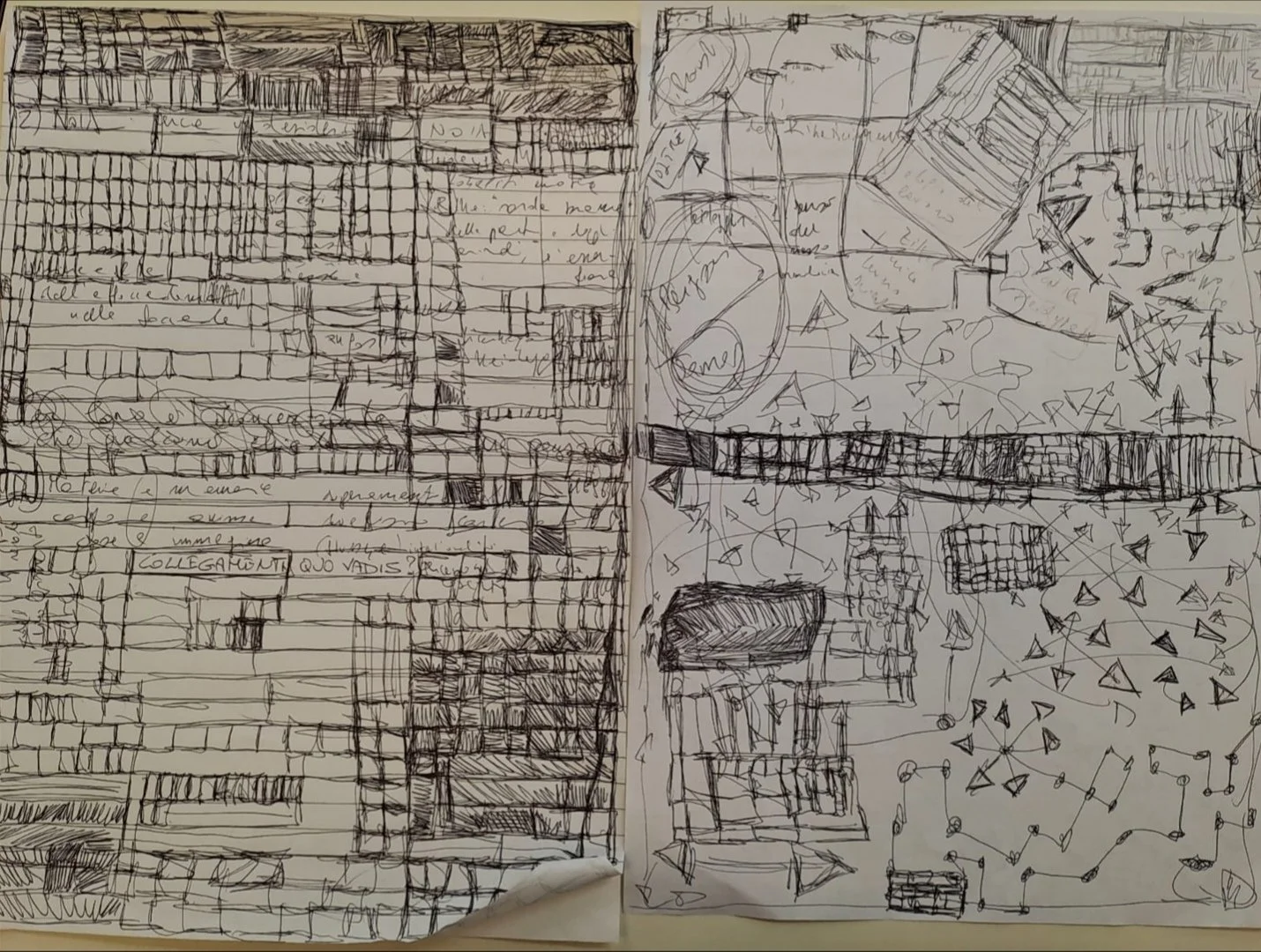
Toni D'Angela, Untitled (Scribbles), pen on paper, Como, Italy, July 1st, 2024. Photo: Elisa Mancioli.
In 1972 Lynda Benglis put together “Mumble”, a work of videoart (black and white, sound, 29 min.) made from a series of tapes that she sent to and received from Robert Morris. The following year Morris used the same source material and more to make “Exchange”, another black and white video, 36 minutes long. We can read it as a response to Benglis’ work, since Morris’ voice-over explicitly addresses her interventions on the tapes.
In his words, she suggested a dialogue, he said yes and immediately asked to use her equipment. There were long discussions as to where this was to take place. Decisions were made and then reversed. Weeks later she told him she had felt invaded by his presence. [1] She would have written in a note, attached to a video monitor: «By now I know who I want to sleep with, but lending my equipment is something else.» [2]
There is always a particular intensity in his voice when he refers to her, almost a tremble. He comments on what she did, tries to reenact what he was shown doing in her version of the video, looking at himself in a monitor that creates a feedback loop (here I am, commenting on my performance, trying to feel my way back to feelings which escape me, as I merely lived through that time). Nothing of what they say in the respective audios is to be taken as the Truth.
Sometimes he seems to be framing her as having more power, clearly she is well into the medium while in the first tape he tried to get out his feelings. So she is the one making a formal artistic effort and he is just expressing his feelings? But they are both hyper-aware of issues of representation, narrative, gender and (a)symmetry, there is even a joke about Wittgenstein abandoning the notion of clarity he had in the Tractatus.
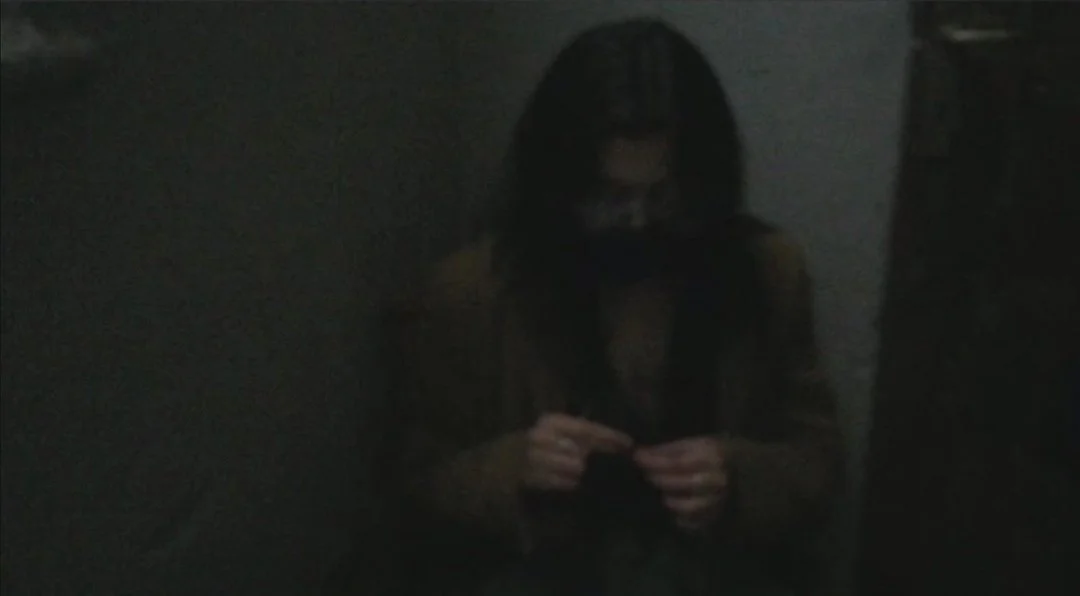
Toni D'Angela, Elisa performing at the Green Station, digital photograph, Alzate Brianza, Italy, December 19th, 2021. Courtesy of Toni D'Angela.
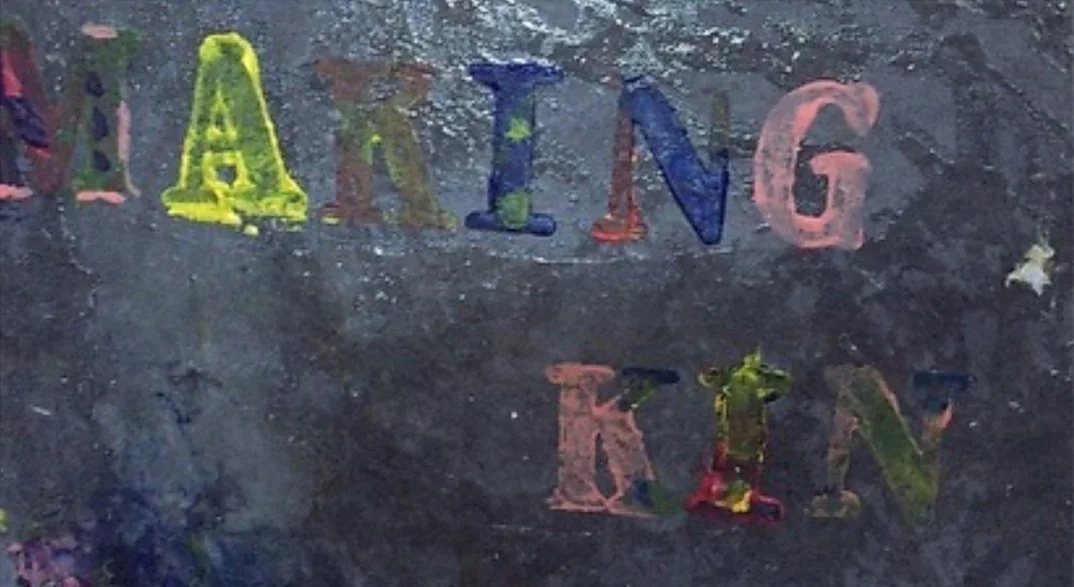
Toni D'Angela, Making Kin, digital photograph of a mixed media piece (33x33 cm, undated), Alzate Brianza, Italy, December 19th, 2021. Courtesy of Toni D'Angela.
Years after finishing the Tractatus logico-philosophicus (1921), where he thought he had solved some of the most important philosophical questions through the clarification of language, Wittgenstein returned to his research and developed a more fluid, pragmatic and relational concept of language.
If “Mumble” and “Exchange” are texts, they don't have one author, they can't be read in a transparent way. They are performances and representations, but also vulnerable, “raw” self exposure: the videos are putting themselves on display for one another, feeding each other and keeping each other alive. Meanings shift and gain or lose layers in the back and forth of the works.
As they cautiously move around each other's remarks and figures, he is obsessively looking for an answer to the question: what is raw material? In economic terms, that is material prepared for production, therefore fixed, quantifiable, and mostly inert, after being already manipulated by human hands. That is difficult to find in video technology, with its constant scanning, but generally in art, and language, too. There is no fixed meaning in language, Wittgenstein knew this very well, but also nothing inert in materiality, as well as nothing that is completely transparent, immediate.
When Morris’ voice utters: “she compressed him into an object, he projected onto her a landscape of his feelings”, we feel the weight of all that they have to take into account in their encounter, the power relations, first of all the objectification that comes with establishing figure and ground, that is the same that comes by using others as means, as Kant would say. But then also whose voice is listened to? Whose work is recognized and valorized? Whose labour is seen?
There is no private experience, a young Marx already knew that our feelings and desires are products of the factory of the world. So we can communicate, we can know what others feel, we can work together: language, in its opacity, still stands as a common ground for our encounters. But when we reach the limits of language, Wittgenstein says, we shan't speak any more. What to do then, when something so complicated and so intense as love happens to us, and there are no words for it?
Art-making was Benglis and Morris’ material response. Their works seem to have lives of their own and to solve the problem of what is incommunicable, not by explaining, simplifying or correcting but by complicating the relationship, by exposing and covering, by playing with the distribution of the sensible.
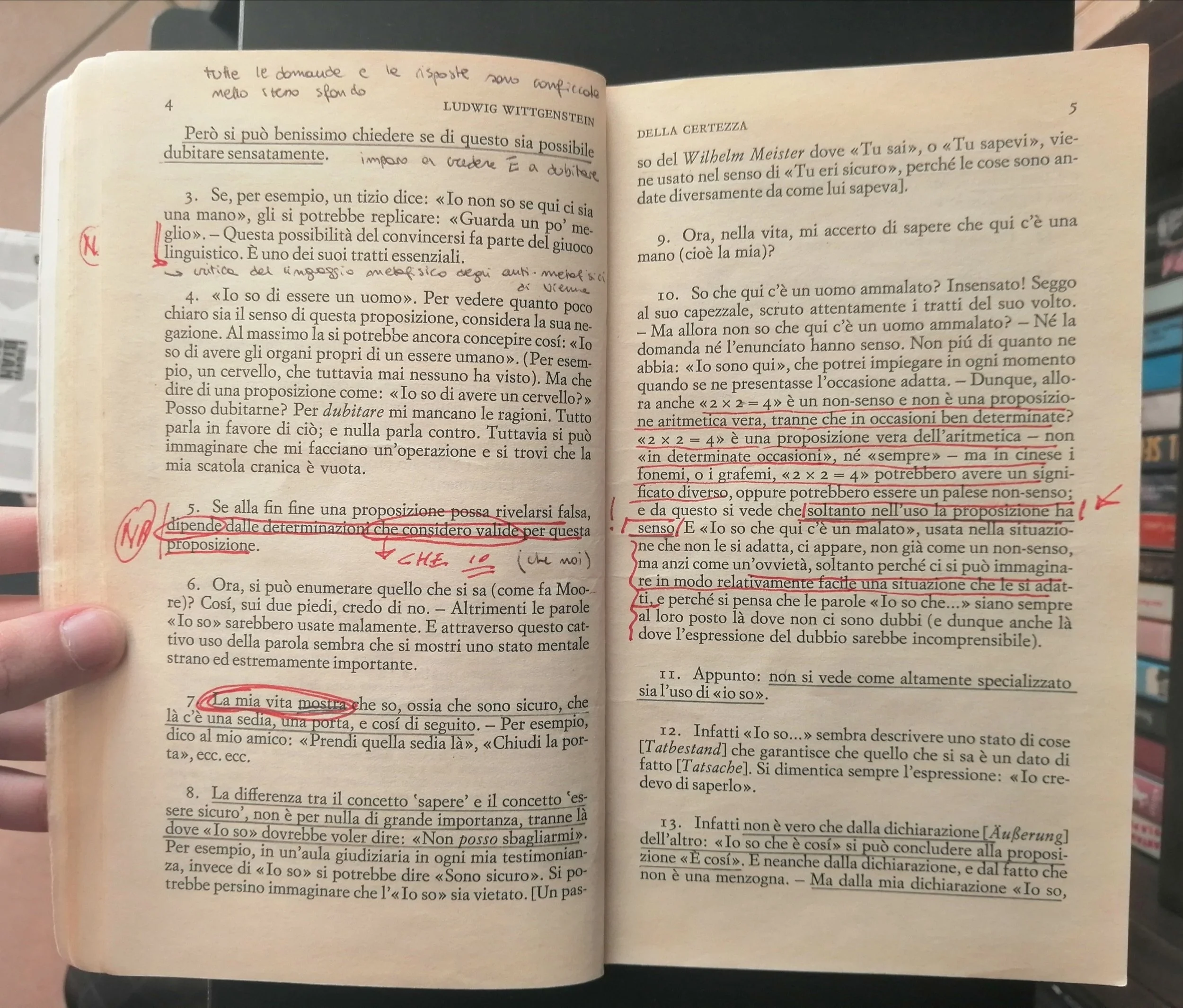
Elisa Mancioli, Two sets of annotations on Wittgenstein's Della Certezza, Milan, Italy, April 1st, 2026. Photo: Elisa Mancioli.
Literature
[1] All the quotes in italics are from Robert Morris, “Exchange” (1973). Video, 36 min, B&W: https://www.vdb.org/titles/exchange
[2] A message written by Lynda Benglis on a piece of paper attached to a video monitor, according to what Morris says in “Exchange”; as with everything said in the tapes, we can't be sure about accuracy, and are meant to not care about who said what.