
Girlhood Through Frontiers
The American frontier is enduringly impressive but feels unimpressed by my transient girlhood. My stories of girlhood so tender in comparison to the fables of the frontier. But through looking to other girlhoods on the frontier, have we left a trace?
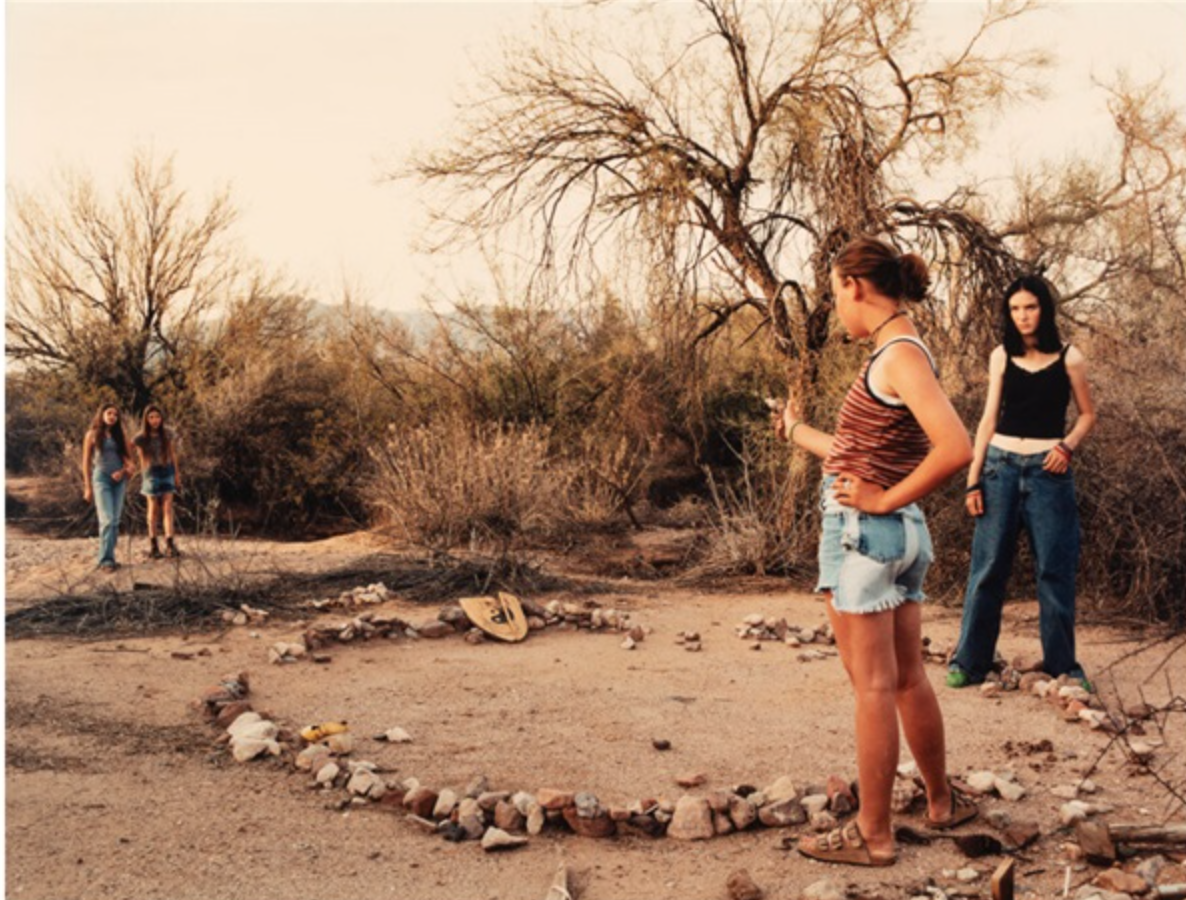
Justine Kurland, The Wild West (2000). Courtesy of the artist.
I grew up on the North American frontier. A place where cowboys became oil rich. Where the vast Canadian prairie tumbles into sharp mountains. With each visit, my once memorized streets grow distant but heavier with memories that I feel are of importance to who I’ve become. The landscape, however, feels difficult to disrupt. The Aspen trees still envelop my favourite park bench on top of the ravine, swaying in the rolling breeze. The mountains ever-present on the horizon on a crisp, clear day. I never get lost because the curvature of the river always leads me back to the 1920s craftsman bungalow I grew up in.
The frontier is thought of as being impressive with its extremes. The mountains are enormous and sharp, the winters are chilling and quiet, and the plains are vast and bare. Amidst this imposingness, part of the mythos of the frontier is that it is untouched, unmarked, and in a way, impressive, but lacking in impressions. The maverick surviving the harsh climate is inherently rugged and masculine; a romanticism arising from the unknown, the undiscovered, and its perceived lawlessness. I struggle to reconcile such masculinity with the frontier, as it is a place that contains my girlhood. I see my own girlhood perhaps as when I felt I had the agency to express myself, but I was unsure of how to express it. Maybe it was the time when I felt no stores made any clothes for me – some seemed juvenile in pastels and patterns, and others hung limply on a body not quite ready to give it shape. When I first started to feel like time was going too fast. A time that feels quiet and personal; a time absent in the imagery and ethos of the masculine American frontier. How do I view my girlhood reflected in a space of such mythology, but that was experienced so fleetingly?
Girlhood through Mythology
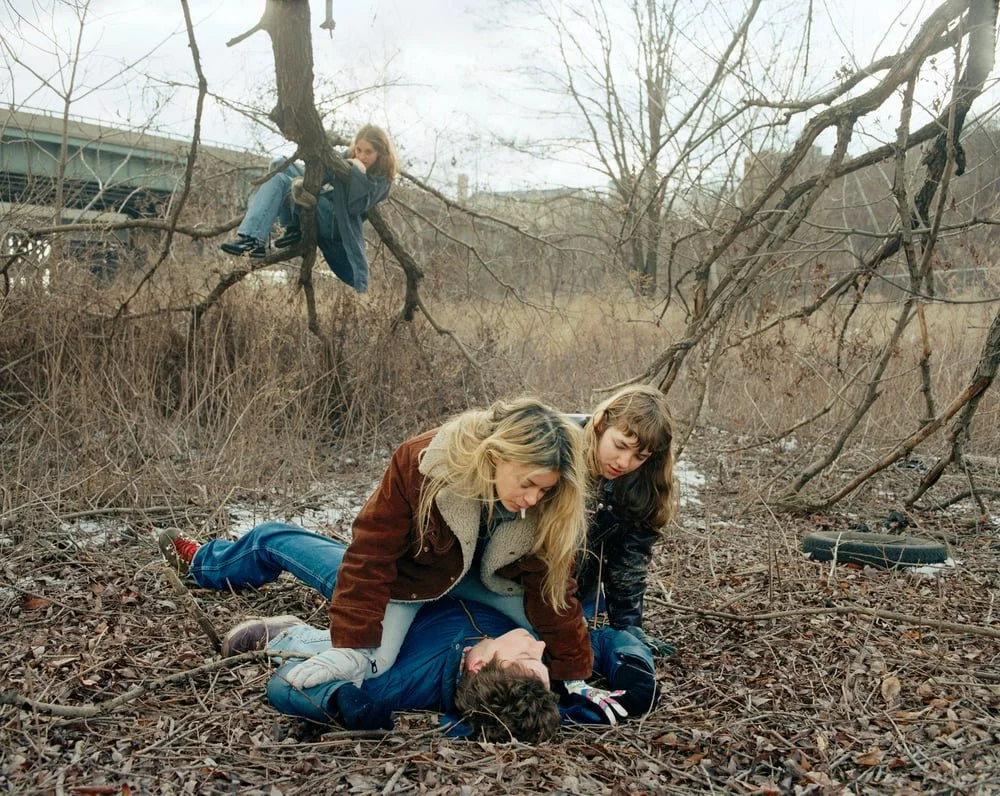
Justine Kurland, Boy Torture: Two-Headed Monster (1999). Courtesy of the artist.
As I make sense of my relationship to the frontier, I gravitate towards Justine Kurland's (1969) photography series Girl Pictures (1997-2002) and Annie Pootoogook's (1969-2016) drawings from the 2000s. Although both are rooted in more reverie than my experiences, it feels truthful in how seriously they take adolescence. Girl Pictures is set within wild and abandoned landscapes. The girls, seemingly teenage runaways, are romantically indicative of a girl-driven adventure, opposite to the pervasive American narratives of white boyhood. There is a fantastical element to the visualized reality of what would happen if girls lived without societal constraints. However, their almost monotony of a distinctly suburban, white girlhood is not something I feel I embody as the daughter of immigrants. Similarly, I'm not Inuit (Indigenous peoples of the Arctic), as Pootoogook's drawings depict. Her colourful use of crayon line drawings invokes a tender sense of ongoing girlhood. The subject matter of the drawings features mainly interior spaces, and supposedly mundane activities like watching TV, preparing food, and families co-existing in shared spaces. The interior spaces are distinctly part of governmental dwelling projects.[i] In their negation of the exterior landscape, her images speak to the imposition of settler colonialism that has irreparably shaped life on the frontier.
Kurland pictures America's wild young women, writing them into a canon of narratives historically reserved exclusively for men. On the nose is The Wild West (2000), alluding to the primary American mythological contribution: the cowboy. The photograph depicts four girls dressed in denim, emblematic of the cowboy. They surround a ring of rocks where a wooden shield lies, split in two. The shield faces a girl holding a pistol with her hand on her hip in a typical "shootout" posture (one-on-one way to settle disputes in lawless territory). The shield, which protects from swords and arrows, represents an Old World battle-style that perishes in confrontation with the New World pistol. Moreover, the shield has a yin and yang symbol, where its fracture can signify a split of a traditional balance, like gender roles. Boy Torture: Two-Headed Monster (1999) depicts a girl aggressively pinning down a boy as spit emerges from her mouth. Simultaneously, the head of her companion emerges to the right of the photograph, making them appear almost two-headed in their shared intense gaze. Their frightening monstrosity subverts conventions of complacent girlhood, further rendering girls as active protagonists in these images. Girl Pictures marks girls' presence both in the harsh landscape and alongside the hegemonic American patriarchy represented by the frontier. The mythological components of Kurland's photographs rupture an existing socially prescribed girlhood by imagining what girlhood can be.
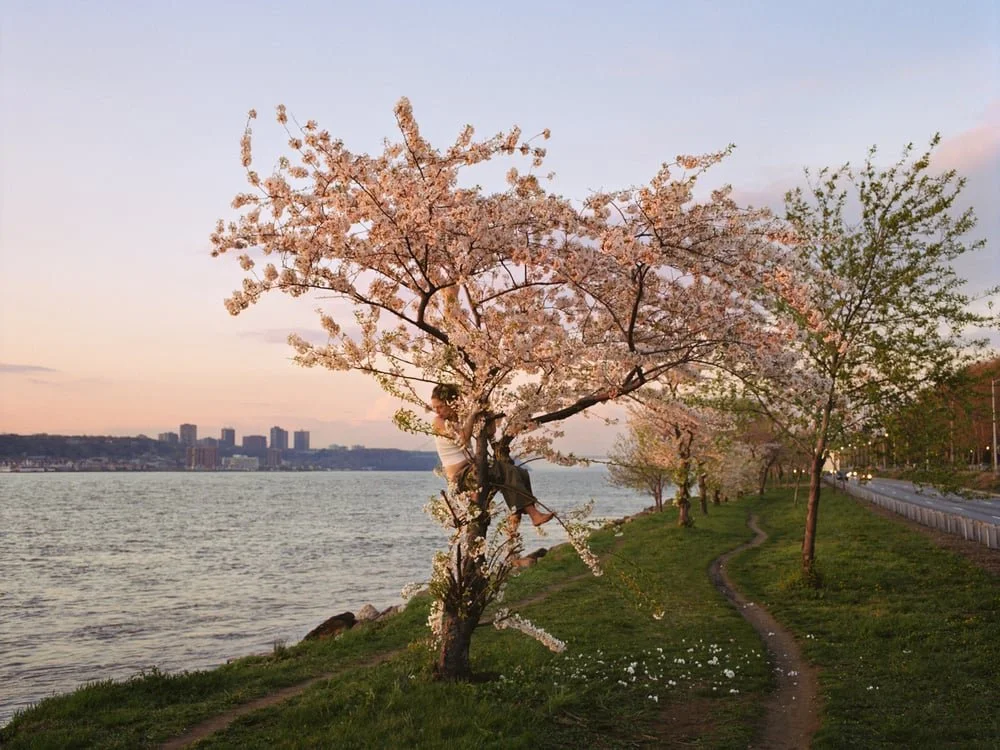
Justine Kurland, Prink Tree (1997). Courtesy of the artist.
Oppositely, Pootoogook rejects mythology in her work. In a time where the Southern market had a quench for the folklore of the frigid tundra and Inuit culture, Pootoogook refutes such an impositionist imagination.[ii] As Canada attempted to carve a national artistic visual program, Inuit drawings were expected to draw upon fables, promoting a palatable cultural export. Dehistoricizing Inuit existence attempted to freeze them in a romanticized and depoliticized past, disregarding their present.[iii] Pootoogook's drawings resist erasure and assert a presence of Inuit girlhood not relegated to folklore. Her use of commercialized products spatiotemporally ground her in a contemporary reality. In Dr. Phil (2006), technology is pervasive. Two outlets have cords extending out from them, connecting a TV, a lamp, a telephone and a CD player. Almost every sense is engaged, indicating that Arctic life is not existing in isolation. Through the window, it's not nature that is seen, but another house, emphasizing the built environment and its removal from nature. Moreover, the "no smoking sign" in the top right corner indicates the trade of products from the South. Pootoogook's work reflects an interiority central to girlhood. Girlhood was experienced through a series of acts, some occasionally banal, many occurring within the home. The search for the mystical arctic landscape is a settler colonial fantasy misaligned with Inuit girlhood realities. Geography shapes a girl's life, but the mediation of autonomy occurs not with the landscape, but with the material interactions one experiences.
Girlhood through Time
Kurland's photographic medium lingers ephemeral time by capturing it in a singular frame. Time is depicted through the close bonds between the girls that require time to develop, even if for slight nefarious means, as in Boy Torture and The Wild West. How the sunlight illuminates the girls throughout Kurland's journey through America, marks the various daily, seasonal, and climatic temporalities. The fluffy blossoms and the girl in a tank top in Pink Tree (1997) indicate a spring dusk. The weighted coats, barren trees, and traces of snow in Boy Torture point to a chilly day. In The Wild West, the defoliated trees among the sand suggest a dry and warm landscape. The passage of time evidences an existence, but one that is devoid of metrics that associate time with the constraints of late-stage capitalism. Kurland's photographs emphasize an alternative girlhood without the typical societal pressures that govern the inherent transientness of girlhood. The camera allows the moments to linger, as if girlhood were not a liminal space of transition, but a liminal space of existence.
Clocks are a recurring motif in the drawings of Pootoogook's work. The ticking clock portrays girlhood as a fleeting time, between childhood and adulthood, unable to be suspended. A time where skills are accumulated, and eventually, the roles of womanhood are to be assumed. Unlike Kurland's photographs, they realize their existence amidst systems of capitalism that commodify time. It takes time to prep a seal as seen in In the Kitchen (2000). It is more costly than buying prepared food removed from its cultivation and preparation context.[iv] However, the time taken to learn and participate in practices that have sustained an Inuit co-existence with the landscape for centuries visibly confronts the imposition of time as the primary dictator of girlhood activities.
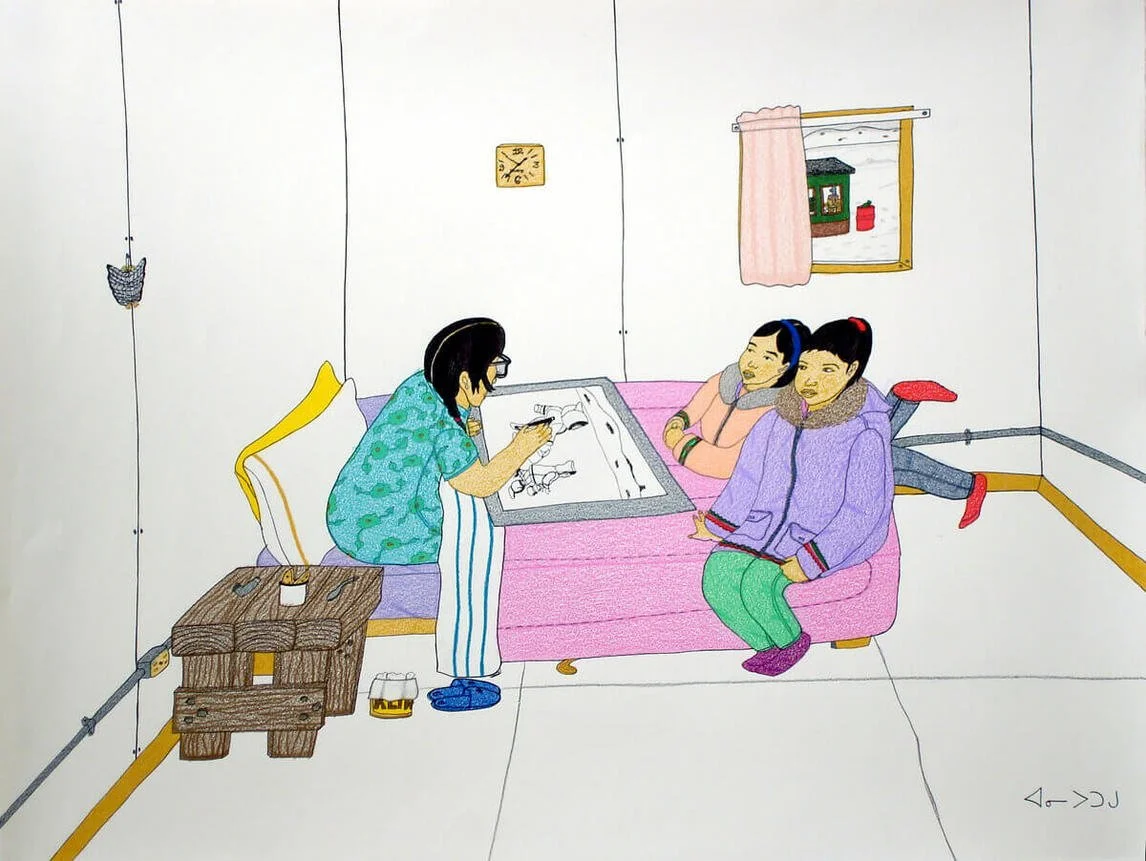
Annie Pootoogook, Pitseolak Drawing with Two Girls on Her Bed (2006). Colored pencil on paper, 50.8 × 66 cm. Private collection. Reproduced with the permission of the Dorset Fine Arts.
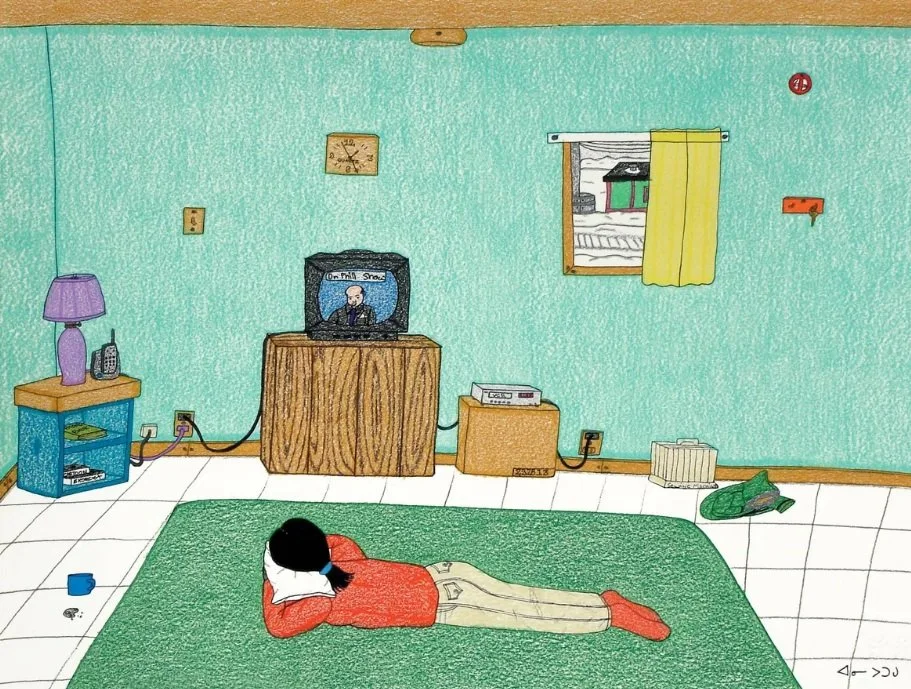
Annie Pootoogook, Dr. Phil (2006). Colored pencil and ink on paper, 40 × 50 cm. Private collection. Reproduced with the permission of the Dorset Fine Arts.
Girlhood is a stage in every woman's life. As each girlhood is experienced fleetingly by the ever-rotating clock, it allows for a cyclic experience as girls become mothers and grandmothers. Through daughters or sorts, girlhood frequently enables itself to be revisited, although rarely re-experienced with the same honesty and rawness as one's own time. Both artists encounter a revisiting of girlhood throughout their artworks. Kurland's first "runaway girl" was the daughter of her partner.[v] They drove to the west side highway by the Hudson River in New York. Nestled in a fraught cherry blossom tree, Kurland captured the first girl in between two modes of transport, the highways and the river, which both approach the same vanishing point as pictured in Pink Tree (1997). She embarked on a journey, driving through the American landscape and finding girls to photograph for her series. As she drove, she re-experienced girlhood through the girls she encountered and sought out.[vi] Similarly, female and artistic lineage is evident in Pootoogook's drawings. Her renowned Inuit artist mother and grandmother, Napachie Pootoogook and Pitseolak Ashoona, respectively, are featured in many of her drawings like Piseolak Drawing with Two Girls on the Bed (2006). The bedroom, emblematic as a space of girlhood mediation,[vii] is significant as the place in which Pootoogook acquired drawing skills that became her medium for representing and mediating her own Inuit girlhood. Photography for Kurland and drawing for Pootoogook can be read as means to revisit and re-imagine one's own girlhoods and their environments of fruition.
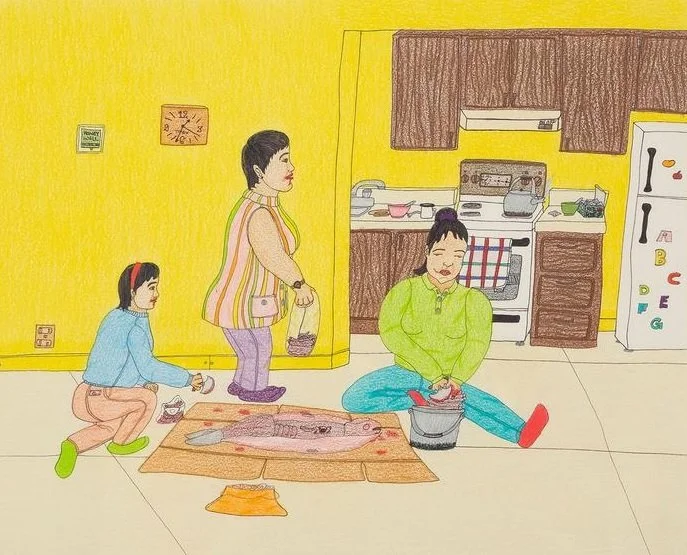
Annie Pootoogook, In the Kitchen (2006). Colored pencil and ink on paper, Pencil crayon / mixed media on paper, 38.7 × 50.2 cm. Private collection. Reproduced with the permission of the Dorset Fine Arts.
Both artists provide rare spaces for girlhood to feature. They both disrupt pervasive narratives and impress a history of maturation amidst the vast landscape through their utilization of daily practices and mythology. As a period of fleetingness and flux, these attempts to capture the movements of girlhood encapsulate an uncertainty about the future, but a certainty in their momentum. As my sunsets glow suffocatingly hazy and the snow rarely provides a blanket of silence beneath the incandescent orbs, I search for a memory of what it was like. These pictures resonate a sense of collective memory, of a girlhood I never quite experienced, but perhaps one that helps me remember my own.
Litteratur
[i] Lefebvre, Haidee Smith. "Annie Pootoogook's Visual Representations of Girlhood: Acknowledging and Recognizing the Presence of Inuit Girls." PhD diss., McGill University, 2019: 90. ProQuest (28248214).
[ii] Pupchek, Leanne S. “True North: Inuit Art & the Canadian Imagination.” The American Review of Canadian Studies 31, no. 1 (2001): 3. https://doi.org/10.1080/02722010109481590.
[iii] Pupchek, “True North,” 5.
[iv] Lefebvre, “Annie,” 121.
[v] Kurland, Justine. “Cherry Bom.” In Girl Pictures. Aperture, 2020.
[vi] Kurland, “Cherry Bomb.”
[vii] McRobbie, Angela and Jenny Garber, “Girls and subculture.” In CCCS Selected Working Papers: Volume 2, edited by Ann Gray, Jan Campbell, Mark Erickson, Stuart Hanson, and Helen Wood. Routledge, 2007: 222.