
Feminist Worldmaking and the Moving Image: A conversation on curation
The following text is a conversation with Erika Balsom. Reader in Film and Media Studies at King's College London, she is a scholar and critic interested in the intersections of art and cinema, and among the curators of No Master Territories: Feminism Worldmaking and the Moving Image. The exhibition, dedicated to the history of the moving image with a focus on experimental or documentary works by women, began in 2022 at Haus der Kulturen der Welt, Berlin and moved to Muzeum Sztuki Nowoczesnej, Warsaw in 2023. It is now open at Kunstnernes Hus, Oslo, until the 3rd of May, 2026.
A version of this conversation is also available in the media & film journal La Furia Umana.
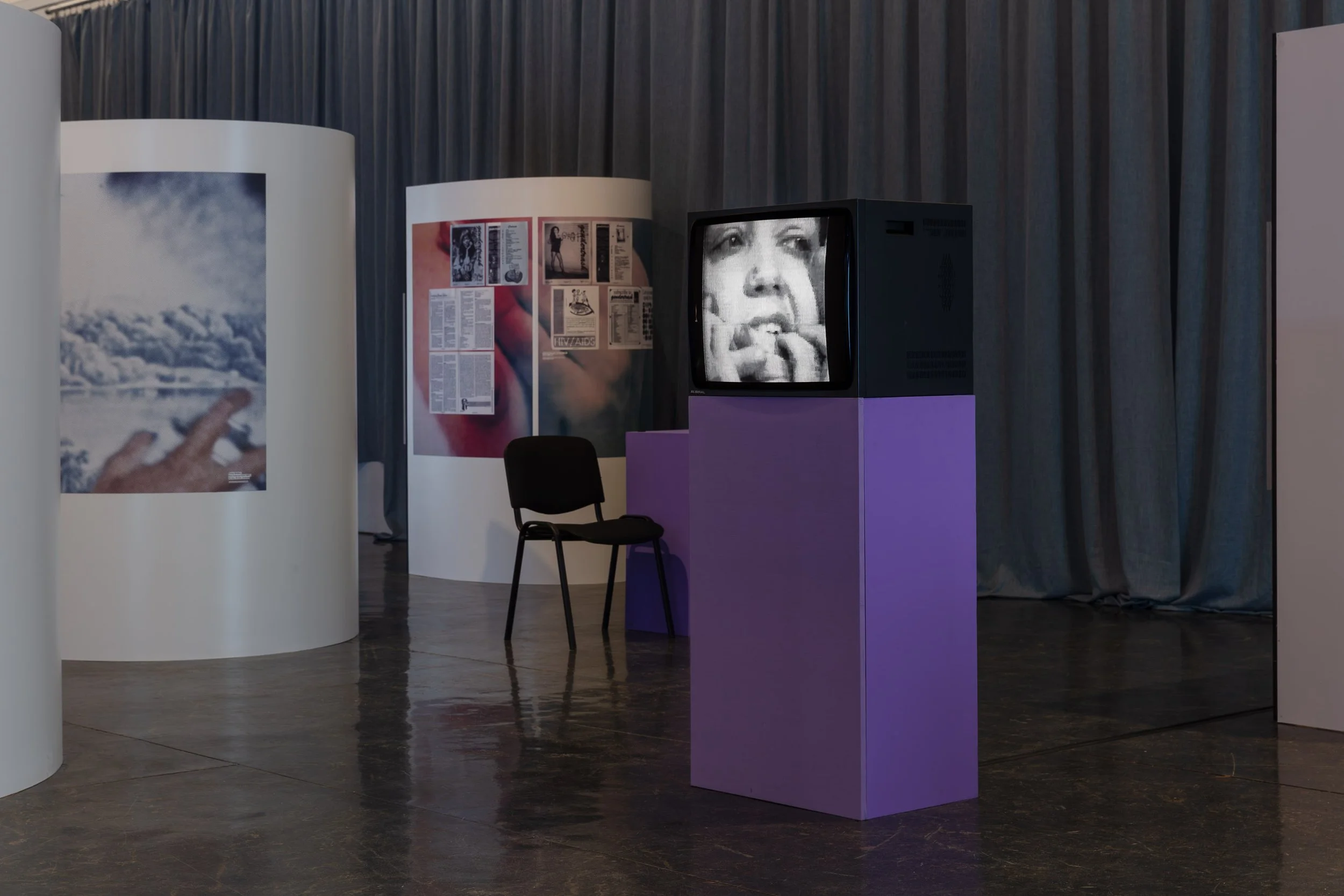
No Master Territories, 13.02.-03.05.26, Kunstnernes Hus. Foto: Tor S. Ulstein, Kunstdok/Kunstnernes Hus.
EM: I went to the exhibition in Oslo, but I couldn’t see it in Berlin or Warsaw, was it a lot different in the different cities?
EB: Yes, in Berlin it was much bigger. There was a larger gallery space that was one single room, the main one at HKW, and we also had a cinema with a very large program, over forty films playing every day. When it went to Warsaw, the gallery space was smaller and there was no looping cinema program. We did a collaboration with a film festival, presenting seven screenings as part of their program, but we didn’t have cinema space as a regular component. In Oslo, the cinema space comes back but in a much more reduced way, with a loop of six films, and the gallery space is a little smaller and divided in two. Oslo is the smallest presentation thus far and has an added focus on the Nordic countries: the cinema loop specifically looks at Norway, Denmark and Sweden, and there are some works in the gallery from those contexts that were not there in the previous editions.
EM: And how did the selection process work for these new Nordic works?
EB: I worked with Silja Espolin Johnson, who is a curator at Kunstnernes Hus and who knows a lot about the Norwegian context in particular. We started with research at the different national cinematheques, and were also in touch with FilmForm, a very important distributor of experimental film in Sweden. By the time we started to do that research, everything else was already in place: the parameters of the exhibition, the concerns, and the sensibility were all relatively clear, so we were interested in making a selection that could complement that.
EM: I’m also interested in the curatorial work related to the space itself, there is obviously no clear, defined path that one should take in the exhibition, especially in Oslo, since you can either go right or left, but was it the same in Berlin, it being in a single space, with only one entrance?
EB: In Berlin, there was only one entrance to the space, but after that it was very free in terms of where you could go. There was really no single pathway laid out for the viewer to follow. In Oslo, you have two entrances, but both spaces are long and narrow, so it’s sort of unavoidable that there will be more of a set trajectory. Nevertheless, the idea was to still allow the viewer to wander and make their own connections.
That said, the arrangement of the works is not random. It was planned with the idea that there are connections that will emerge across the different works, clusters or constellations that resonate together in ways that draw out some of the themes of the exhibition. For example, in Oslo we have Untitled 77A (1977) by Han Ok-hee next to Schmeerguntz (1965) by Gunvor Nelson and Dorothy Wiley, both of which are very montage-driven works that have a kind of riotous energy and which are instances of women working together to intervene in an existing economy of images. The films are extremely different and were made in different places and different times, but they have this connection.
EM: Yes, they resonate.
EB: In other cases there are more straightforward content-based links, such as a cluster of works that all deal with indigeneity and take an intersectional feminist approach to thinking about settler colonialism.
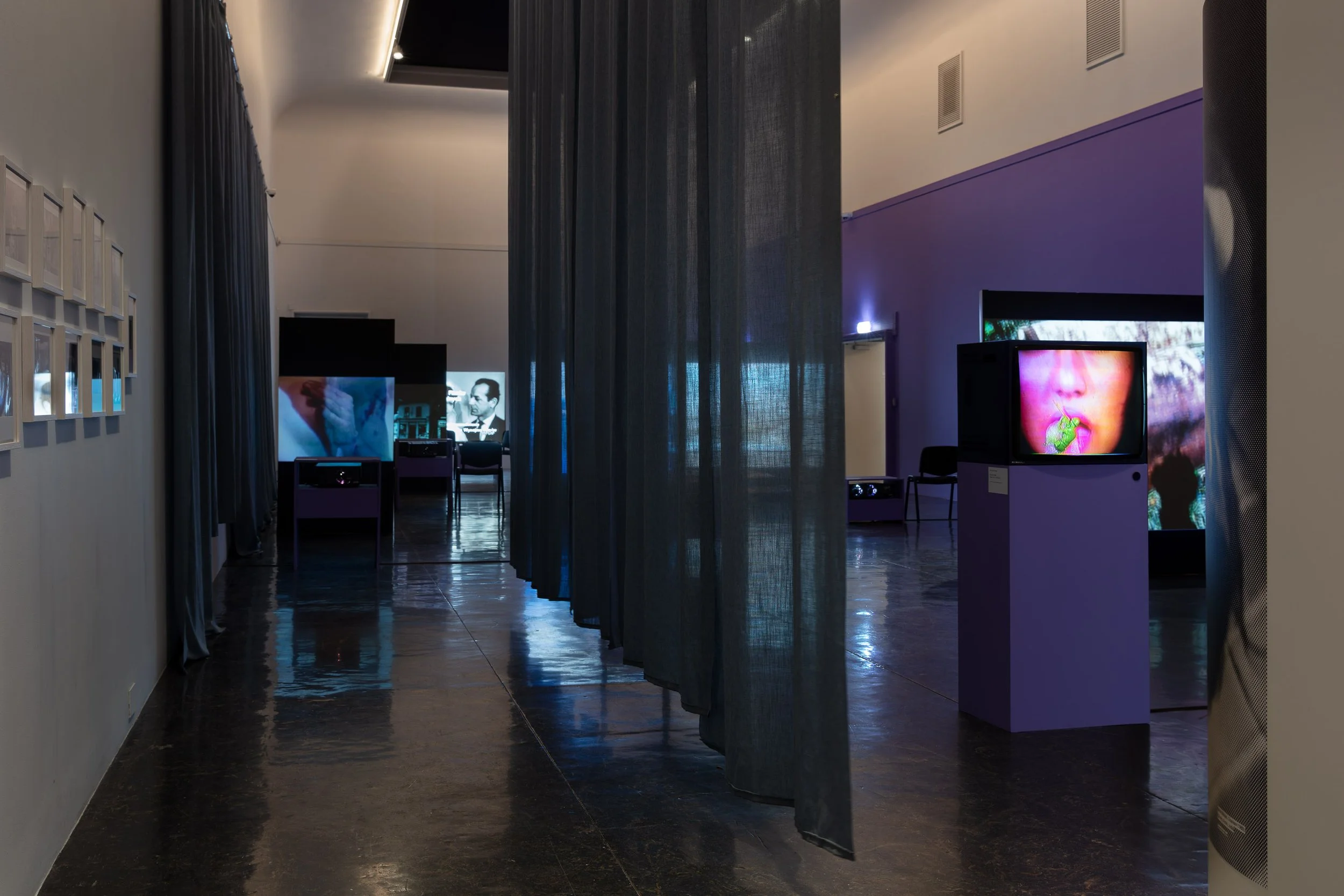
No Master Territories, 13.02.-03.05.26, Kunstnernes Hus. Foto: Tor S. Ulstein, Kunstdok/Kunstnernes Hus.
EM: Why did you choose to also display non-moving images?
EB: It was important to give some material texture to the space. We did this by the inclusion of photographic material, through the architectural components of the space (including the use of fabric), and through the display of lots of archival material. It is an exhibition devoted to the history of the moving image, but when you’re surrounded by screens everything can feel very electronic and virtual, so we wanted to make sure the exhibition felt like a real, actual space that you are really in. For me, the presence of the documentation is important in understanding why this is an exhibition and not a film program that would happen in a cinema. I will be the first person to say that for most of these works, the cinema is the best place to see them, in terms of temporality, perception, and so on. If you’re going to bring them into the gallery, the question becomes: why? The contextualizing function of these documents is my biggest answer to that question. We see that these are not just autonomous artworks or film “texts” - as we often say in film studies - but are embedded in networks of production and distribution, in social contexts. Many of the documents on the back of the screens speak to the lives of these works and the people that made them.
EM: So the archival material doesn’t become an afterthought, something that you read after you see the movie or the video.
EB: Yes, and I think that signals our approach to the field, to this area of practice.
EM: I understand what you were saying about the risk of it feeling virtual, and I think placing the photographs on the walls, at the very borders of the exhibition, worked in making the space and the room(s) felt. And the moving images are inside the space, like “objects in the room” and not like windows on the walls, so that the view is always somewhat obstructed, there’s never a completely clear visibility, but at the same time you could not only see one work at a time, you can see most of them together.
EB: The documentation is one reason for this to take place as an exhibition, but you’ve just mentioned the second reason: you can see multiple screens together, such that interesting forms of soft montage can emerge between screens. This is an argument curators make all the time about moving images in gallery spaces and sometimes I’m not really persuaded. I think, “No! I would rather just watch one film!” But there are certain places in the exhibition where one can get good vantage points across multiple screens, with rhymes that are interesting to think about.
EM: I think the audio also works in this direction. The first time I went I was using the headphones, being good and pointing at each audio track to go with the corresponding work and trying to focus on each one; the second time I went with my professor and classmates, and these are art history and curatorial studies students, so I was paying more attention to the whole, with the headphones resting around my neck. One of the things I found interesting was the resonance between So much I want to say and the intermittent sounds coming up from my headphones, without even pointing at the different works. So I’d say it works as a collage of images and sounds.
Moving around the space I also enjoyed feeling the heat of the projectors, and even though it is all presented digitally, I was wondering about how much did you take into account the different media?
EB: There are some works of video art that are presented on CRT monitors, like Mona Hatoum’s So Much I Want to Say (1983). This monitor-based presentation is a gesture to the fact that these are non-cinematic works, not intended for projection. We kept with the historically accurate presentation format. But with everything else, it was more a question of using different projection sizes to create an interesting visual landscape and in some cases to direct attention. An example is Sara Gómez’s Mi Aporte (1969–72), which is positioned towards the back of one of the spaces. In that case, the larger projection size is used because it’s a longer work and a work that we wanted to signal as very important, a place where you might want to sit and really spend time.
In general, this is an exhibition dealing with film history but it would’ve never been possible without digitization. From the research phase to the display phase, digitization is an absolute condition of possibility for a project like this. We simply would not have been able to travel to six continents and watch film prints to do the research. So much of this material has been digitized in the last 10 to 15 years and that is what made this wide, transnational research possible. And it is also what makes this multiscreen display possible.
We list all the original formats in the booklet. This was important to me, because it emphasizes how many of them were made in 16mm, Super 8, or videotape. It is important to note the prevalence of small gauge filmmaking and non-professional formats; there are very few works on 35mm and the ones that were originally on 35mm were coming from Cuba, Poland, East Germany. It’s not a coincidence that it is in the socialist world where we have…
EM: The means?
EB: The means, exactly!
EM: I was smiling before because one of the friends I went with is a filmmaker and he was not exactly saying that “only cinema can exhibit films adequately”, but he was… skeptical. Thinking, where is the respect for the work? Would I, as a filmmaker, like seeing my work displayed like this?
EB: I am that person! In the past, I have reviewed exhibitions and made exactly that point. I’m very amenable to that point of view. On the other hand, would it be better if it were not shown? That is the alternative, I think. One could do a film screening once, but you might have fifty, one hundred people coming to see it, whereas in Berlin ten thousand people came to this exhibition. Making the work available to a public on an extended basis is important; a lot of these works are not openly available online, and because they are short, experimental, and/or documentary works by women, they’re also less likely to find a home within a cinematheque or a film museum context – still a very auteur, art cinema-driven space. I love that space; it is more my natural habitat than a contemporary art gallery. But I would say to your friend: I agree, it would be better to see them in the cinema, but given the kind of programming that tends to happen in those spaces and given the access to audiences, the sacrifice is worth it.
EM: And to be fair, one always has the option to sit down, headphones on, and watch a video or film from start to finish. I really don’t believe that the other works interfere with that too much, and I tried it!
It is also maybe tiresome to only think about the intention of the author. Maybe the intentions of some of these authors were not explicitly feminist but we are still meeting and responding to the works as feminist, so is that also a lack of respect? Any work from the past is somewhat decontextualised. But I like this kind of sabotage of intentions, or even of the works themselves. That could be because my natural habitat is more the contemporary art gallery than the film museum!
EB: We also have to note that some of these works were made on film, yes, but they weren’t necessarily made for cinematic exhibition. They were shown in community centers or in underground parties or in classrooms… Cinema is not confined to the movie theater. One of the things about Super 8 and 16mm is that these are much more portable formats than 35mm, so it’s much more likely that they are going to be shown in a wider range of spaces. It is not like they were always in the cinema and now we have transported them into the gallery. They were in the cinema and in homes and in community centers, etc., so that is a different kind of migration.
EM: One of the other people I was at the exhibition with commented that it is just like politics: you have to make a decision on what to focus on, you need to decide where you want to sit down and what you want to look at. The exhibition is making more things visible, but the viewer is trusted with the agency to choose what to work with, in this living archive.
EB: No one is expected to see everything. It is a self-directed experience.
EM: So I did read your “Reflections on an Exhibition” from 2023 but do you still want to tell me more about how this whole process started?
EB: It started as a very broad research process that involved both formal and informal collaborations with different researchers, curators and artists. There were some people formally hired as research collaborators, but I also called in every favor I possibly could, in terms of writing to friends of mine asking, “Hey, if there is anything you think I should really look at, please let me know.”
I also did a lot of research, looking at old festivals catalogs and publications, going back to the 1970s and 1980s and pulling out all the titles that I didn’t know about. The first thing that my co-curator Hila Peleg and I did was to go through the Arsenal catalog in Berlin and basically look at every film by a woman that was not a fiction feature film and that we didn’t already know about. We started to discover certain figures, certain concerns, and then, once we had amassed a lot of material, the next step was to create a conceptual map of the different forms and the different political positions that were emerging. Then we organized the selection of what we found most compelling or most urgent to show, and did so in a way that would give a balance of different places and positions. It was not ultra-methodical. As someone who’s coming from an academic background, I’m used to a more systematic, rule-based form of research, where you have to really set your parameters strictly. This was much more intuitive, and that looseness was important. For instance, the show is often described as primarily showing work made from the 1970s to the 1990s, but especially in Berlin it had a much bigger temporal range, going as far back as the 1920s. It was important to not have a fixed starting point and to understand this field of practice as a more fluid, longer history. I had a sabbatical from my teaching job at the university so this is how I spent my pandemic.
EM: I was going to ask, how long did that take!? And also: even though there are no strict temporal limits, why the focus on those decades? Was it a choice or was there just more work available?
EB: Following the work! It really is in the late 1960s that, in general, experimental filmmaking blows up everywhere. This is also the moment for women’s movements in many different places and that continues until the 1990s. And after that, it is not like there is no more feminist work being made, but the discourse shifts and the media landscape shifts. We wanted to make a show that was about looking back at an earlier moment, to see what we could learn from that now. I had a feeling around 2020 that there were many debates happening about the politics of representation as if no one had ever discussed these issues before! I knew these discussions from my time as an undergraduate in the early 2000s, learning about 1990s’ discourses of feminist film theory and practice. The idea was that there was still a lot to learn from the past.
EM: I see what you mean. I was thinking about this when I thought about Han Ok-hee and queer joy, there is much inspiration to be drawn from that Seventies energy. These are good tools - and maybe this is not the best choice of words - it is a good way to envision and reimagine futures, it’s not just looking back at the past for the sake of doing so!
Something about this makes me think back to the Nan Goldin exhibition that I saw at HangarBicocca, Milan, but was previously at Neue Nationalgalerie in Berlin. The association probably comes from talking about queerness, which is presented with such intensity in Goldin’s slideshows from the Seventies to recent years; but there is also some kinship between the architectural pieces designed to respond to the slideshows and No Master Territories’ display. These are not just black boxes, and in a similar way they transport us back to those decades to feel the liveliness of our (queer, underground, unfinished, becoming-minority) Archive.
EB: One thing I didn’t mention when you asked me about how we selected the works is that we specifically wanted works we thought were not super widely known. We were not interested in showing canonical works again. Instead, we wanted to try and give a sense of just how much is out there.
EM: I see. Another question that came up during the discussion we had with the professor, since we’ve been talking about institutional critique, can we consider this a form of institutional critique? It is at the very least a kind of canon critique, since as you were saying it is mostly made of lesser-known works, at least lesser-known to us.
EB: That’s a really interesting question. The show embraces the art space as a place where these works can be shown and made visible. In that sense, it is not institutional critique at all, but rather more a kind of appreciation of what the art institution can offer as a space for a public to engage in thinking, an embodied space that is offline, with a special relationship to perception, time, and reflection. So if it is an institutional critique at all, it’s maybe a critique of cinematheques and film museums. I had a conversation about the exhibition with a French film critic and she said to me: “I don’t think this project would’ve come from within a film museum, it had to come from contemporary art”. And she’s right: I can’t imagine the British Film Institute or the Cinémathèque Française putting together a program for the cinema with this set of works. In that sense, it could be seen as an implicit critique of certain programming practices and hierarchies of value that still prevail in those contexts. There are of course exceptions, and lots of amazing work being done. The TIFF Cinematheque in Toronto, for instance, invited us to do a version of the programme in their cinema, so I would never want to set up a big antagonism towards film institutions, but I do think that the contemporary art space is more open to this kind of work.
EM: That could be, yes. This reminds me of a talk that Judith Butler had in Venice, in 2023, on how during the pandemic we were missing going to art museums and galleries and having those meeting grounds, almost common spaces - even though we know they are not perfect - similarly to what happens here in Oslo, where the exhibition has a dedicated room with books and resources, and chairs around a table and, if you’re an art student, the entry is free!
EB: And of course there are still all kinds of issues and exclusions around how the contemporary art sphere operates, and I would never want to overlook them. However, in the broader scheme of things, these places can feel really like sanctuaries!
EM: They do! So what are your next projects? Anything special that you’re working on?
EB: This research hasn’t ended for me. In fact, maybe as an Italian you’ll be especially interested in how it has more recently developed. In the first version of the exhibition in Berlin, we showed Processo per stupro (1979). It wasn’t included in Oslo or Warsaw because we were not able to get the rights for the film, since RAI will not give anyone the rights to show it publicly. At HKW, we showed it nevertheless, alongside wonderful documentation and two gorgeous Super 8 films by Annabella Miscuglio that are portraits of her collaborators on Processo per stupro, Paola De Martiis and Rony Daopoulo.
I always knew that after the exhibition opened, I would go back to being “a good academic” and would choose a smaller section of the material for deeper research and writing. I became so obsessed with the story around Processo per stupro, the media coverage, and the fact that now it’s not able to be circulated, and so I decided to research the film and the collective of women that made it. I thought that if an important film like this cannot be officially shown publicly, writing about it can be a way to circulate it by other means. I recently published an article about Processo and am now working on the video that the collective made after, AAA Offresi (1981), which was censored and is now lost. Working on a lost film poses challenges and opportunities. I think it’s an interesting question for feminist historiography: do you only look at finished films or is there a special importance in also looking at unmade, unfinished, or lost films? We had some gestures to this idea in the exhibition. In Oslo, we included Jocelyne Saab’s Palestinian Women (1974), which is an unfinished, censored film.
EM: By all means, tell me more! Are there any sources, or descriptions of AAA Offresi?
EB: There are so many! But the material itself is gone. It was on the front page of the Italian newspapers for like a month when the censorship happened and it became a political scandal, so there are a lot of paper documents. The filmmakers were also put on trial, charged with invasion of privacy and facilitating prostitution, and I managed to get into the court archive in Rome and go through these documents. It’s very interesting because you have major intellectuals like Dacia Maraini giving testimony!
EM: That is interesting, yes! I understand why you chose this to focus on.
EB: So this is a way that No Master Territories continues, for me. And I still plan to do smaller exhibitions based on some of the documents and films related to AAA Offresi, but it is now more of an academic project.
EM: Are you going to move No Master Territories somewhere else, too?
EB: I would love to, but someone has to invite us. It is very sad that it never happened in the UK, where I live, or North America where I’m from. But it’s also been four years now since the first version in Berlin, and there have been many other smaller presentations, like at MAXXI in Rome, where the Fondazione “In Between Art Film” invited us to do a looping selection of works. We have done different iterations, such as the film program at TIFF, and another one Open City Documentary Festival in London, so I’m also fine moving on to my Italian project.