
The Lettuce Baby
An infamous part of my family vacations is walking around endlessly until my Dad decides on a restaurant that is up to par with his standards. Unfortunately for my tactful complaining, the food is usually mouthwateringly good and I have to sheepishly retract my comments made in a previous state of desperation (although I sometimes suspect that the food is so delicious because of how long I had to wait). An exception however, is a night in Prague where our gurgling stomachs fell prey to one of those waiters that harasses you on the street. The ambience felt off, like those pseudo Irish pubs found in every corner of the world with paraphernalia on the walls that feels flimsy and gauche. We were seated at a table underneath what came to be known as the Lettuce Baby.
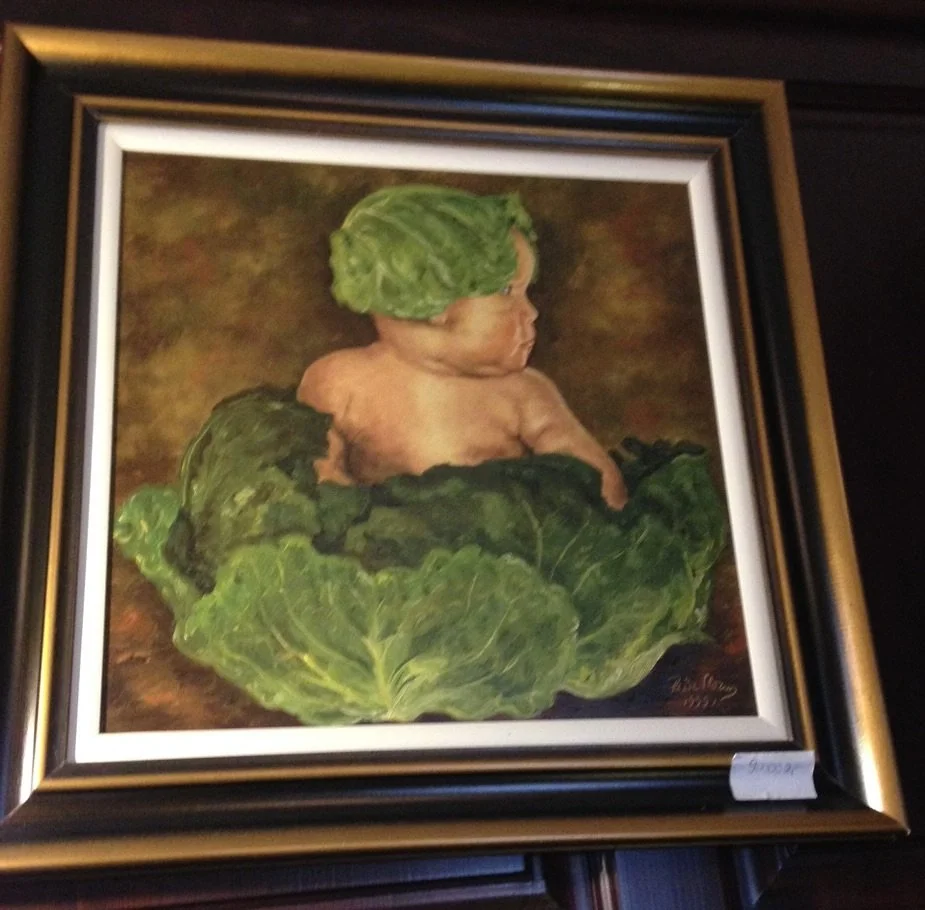
The Lettuce Baby. Foto: Pablo Flechas
It was an oil painting of a baby wrapped in what we thought was lettuce, with a leaf on top of its head like a cute hat. Like a very literal cabbage patch kid. In our hypoglycemic delirious state, my brothers and I made a crude joke about being so hungry the Lettuce Baby looked appetizing. Everything about the meal was objectively horrible: it took forever to flag down the waiter, the fries were limp, and it seemed like a sticky film hung over the atmosphere. But alas, in the “oil lamp” lit dining room, we kept joking about how discovering Lettuce Baby was the real treat in its preposterousness.
Every now and then, a sure-found way to elicit giggles in my family is to say you’re hungry enough to eat Lettuce Baby. But recently, I began wondering, did anyone seriously sit down to paint such an image? There was definitely a historical incongruence that I found unsettling, but I couldn’t exactly place it. Why did the painting feel so inauthentic? In the era of AI generated images, it's the pinnacle of what I feel a Facebook mom would struggle to discern as real or not. I then did a Google Image search of the painting, and found out it is actually a painting of a photograph. Even more absurd. The original photograph is titled Cabbage Kids by Anne Geddes, and actually features a set of twins, each seated in their own cabbage with the comical leaf over their head as they look at their mirror image.
Initially, upon examining the photograph, I made a mental note that I should probably eat more leafy greens as I apparently can’t seem to differentiate cabbage from lettuce. But as I delved deeper into the work, I realized it was a whole series of babies in a garden. Apparently it was quite the 90s fad of baby photography, and it was possibly the nearest I’ve ever been to wanting to be a millennial. I’ve since daydreamed about such veggie-fied images of my baby-self as a fridge magnet. It would just be a gift that keeps on giving. And apparently that is what Anne Geddes photography did. In their weird cuteness, these baby photographs became a commercial household staple worthy of calendars and notecards. Now, thirty years later, I’ve occasionally spotted such photographs at the thrift store, where I find they distract me while scrounging for a nice frame.
Thus, amidst the photograph’s commercial quality, it is even more peculiar that I encountered it as an oil painting. It’s not quite the “fine art” of photography that would render it worthy of photorealism. The inversion of photography to oil painting is indicative of an attempt to elevate the artistic quality of the work. However, the final product looks incongruent, almost deceiving. The magic of Geddes photography is their whimsical quality and the joy of the babies being photographed (anyone who has attempted to keep a baby happy for long enough to shoot would know this is no easy feat), and I see an appeal in the 90s craze. Thus, turning Cabbage Kids into Lettuce Baby doesn’t quite capture the quality of making babies comfortable in a studio. Moreover, oil painting and realism feels so mid 19th century, but dressing a baby in cabbage was unheard of at the time. Thus, there’s this sentiment of attempting to historicize the image by painting it, while also giving one a good chuckle in its inherent ludicrousness. In some ways, perfect for a tourist trap tavern that is cosplaying heritage without the actual kitchen chops to support it. Such a phenomenal decoration choice for the establishment, that it has become one of my most memorable meals.