
"I saw my life branching out before me like the green fig tree in the story."
— Sylvia Plath, The Bell Jar
I aspire to be so many things. How could I fit them all? Even for this article — what path to follow?
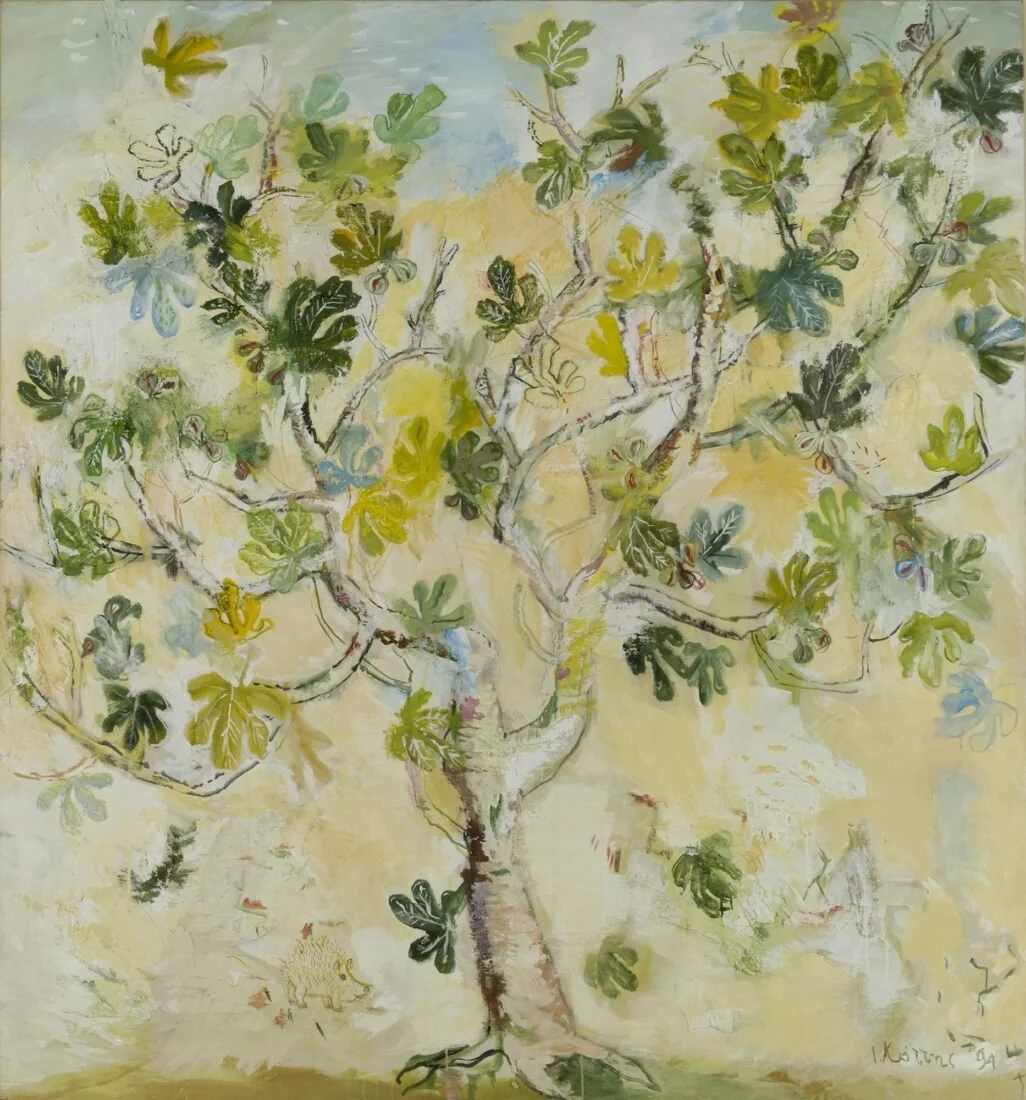
Giannis Kottis, Fig Tree (Συκιά), 1994. Mixed technique on canvas, 222 × 207.5 cm. National Gallery – Alexandros Soutsos Museum, Athens. Image source: National Gallery of Greece.
The first thing that drew me to this Giannis Kottis painting was its size, over two meters of canvas. But yet it feels incredibly intimate. When I first saw it at the National Gallery in Greece, it immediately reminded me of our fig trees in my family’s summer house, where we have spent every summer since I was born. When I went back there this past summer, the image of the fig tree kept replaying in my mind. Kottis layers the branches in a way that feels both rooted and restless. It is not a neat, illustrated tree. It is heavy and complex. Looking at it, you understand why Plath’s image is so overwhelming: it is beautiful, but it takes up the whole room.
It is a mystery to me, but I have always felt drawn to Sylvia Plath — to her thinking, her logic, the way her mind moves. All my life up until now, I have been trying to figure out what I want to be, where I want to end up. I found her book one day, roaming the library. It seemed to appear at a moment where I felt I was in need of some life guidance. I read it in a week I remember mostly as a feeling, as someone had drawn a diagram of something I couldn't name. In the novel, Esther Greenwood sits in the base of a fig tree and observes her possible futures ripen above her :
"From the tip of every branch, like a fat purple fig, a wonderful future beckoned and winked… I saw myself sitting in the crotch of this fig tree, starving to death, just because I couldn't make up my mind which of the figs I would choose." [1]
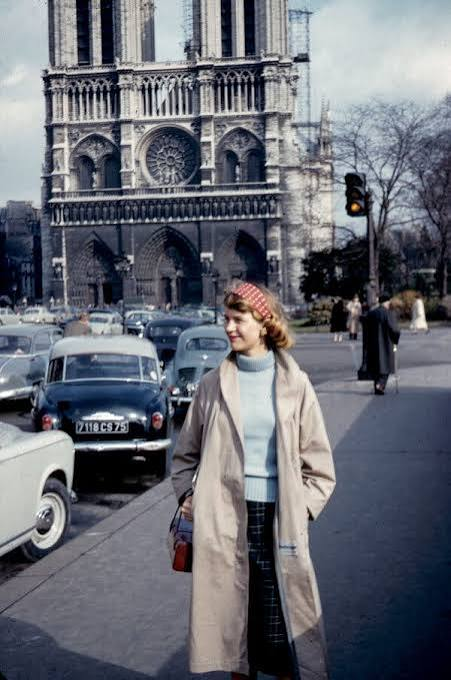
Sylvia Plath in Paris, 1956. Photograph. Image source: Dave Haslam, "Sylvia Plath Walking the Sunny Side of the Street," Substack, September 28, 2023.
She cannot choose. The figs swell, then darken, then drop. What Plath drew, without naming it, is FOMO (Fear Of Missing Out) — not the fear of missing what other people are doing, but the fear of missing the selves you might have been. Perhaps that is how I needed it explained, a personal projection, a way to justify my own questions.
Some would say there is serenity right before choosing. The quiet before the storm, when every fig is still on the branch and none of them has fallen. When you feel lucky regarding the abundance in front of you. I have started to suspect that this quiet is the only part of indecision I actually enjoy.
The choice is yours but most of the time is affected by others. It is made in front of people who have opinions about it — people who may think I am destined to follow another path than the one I chose. The fig tree is a private image: one girl, one tree, no audience. The fear of choosing is rarely private. We choose with other people watching, and we imagine their verdicts before we imagine our own.
Esther, the protagonist, was constrained. A young girl in a world where she stands observing, kept on the outside but never taking part while being fatigued and displeased. Constrained by expectations, not by lack of ability. Her options were narrowed to the expected marriage, motherhood, and domesticity, and she feared those would ruin any chance of a fruitful future. My problem is the opposite. Nothing is forbidden to me; everything is possible; and that is somehow worse. I am trapped by a list that is too long, and I cannot make myself choose from it.[2] It is difficult to comprehend that not everything can be done all at once. And sometimes, indecision equals inability to move forward.
The same image looks the same from both sides. Starvation looks identical whether the tree has three figs or thirty. The tragedy in the novel is that the plenty is unusable; the comedy of my own life is that the plenty is endless and still unusable. "Delay is a decision," I wrote in the margin, and then sat with it for a while.
But time moves on, and options wither. I have so many choices — and still I wonder whether I have little time, or whether I am simply rushing to achieve everything in my twenties. What happens after I choose? What happens after I achieve? Emptiness comes and goes. It never quite leaves my mind. Everything could be different in a year from now, as it was a year ago. What if all these choices make us lose the thread? And where do I stand? [3]
And still I keep moving. I fill my life the way you fill a silence. I move through places, people. My life starts again every other semester. It looks like ambition, and maybe it is, but it is also a way of not standing still long enough to notice what I have chosen. If I never stop, I never have to find out whether I chose well. The fig tree is still. I am not.
Several months later, the image has left the book and is stuck with me. It is not a metaphor but something you see and face. I have found it reprinted in another book — the fig tree passage set alone on a page, offered as advice rather than as a story. I came across it in the book Everything I Know About Love by Dolly Alderton. [4] It is a book that focuses on redefining what "love" means as a young woman grows from her teenage years into her thirties.
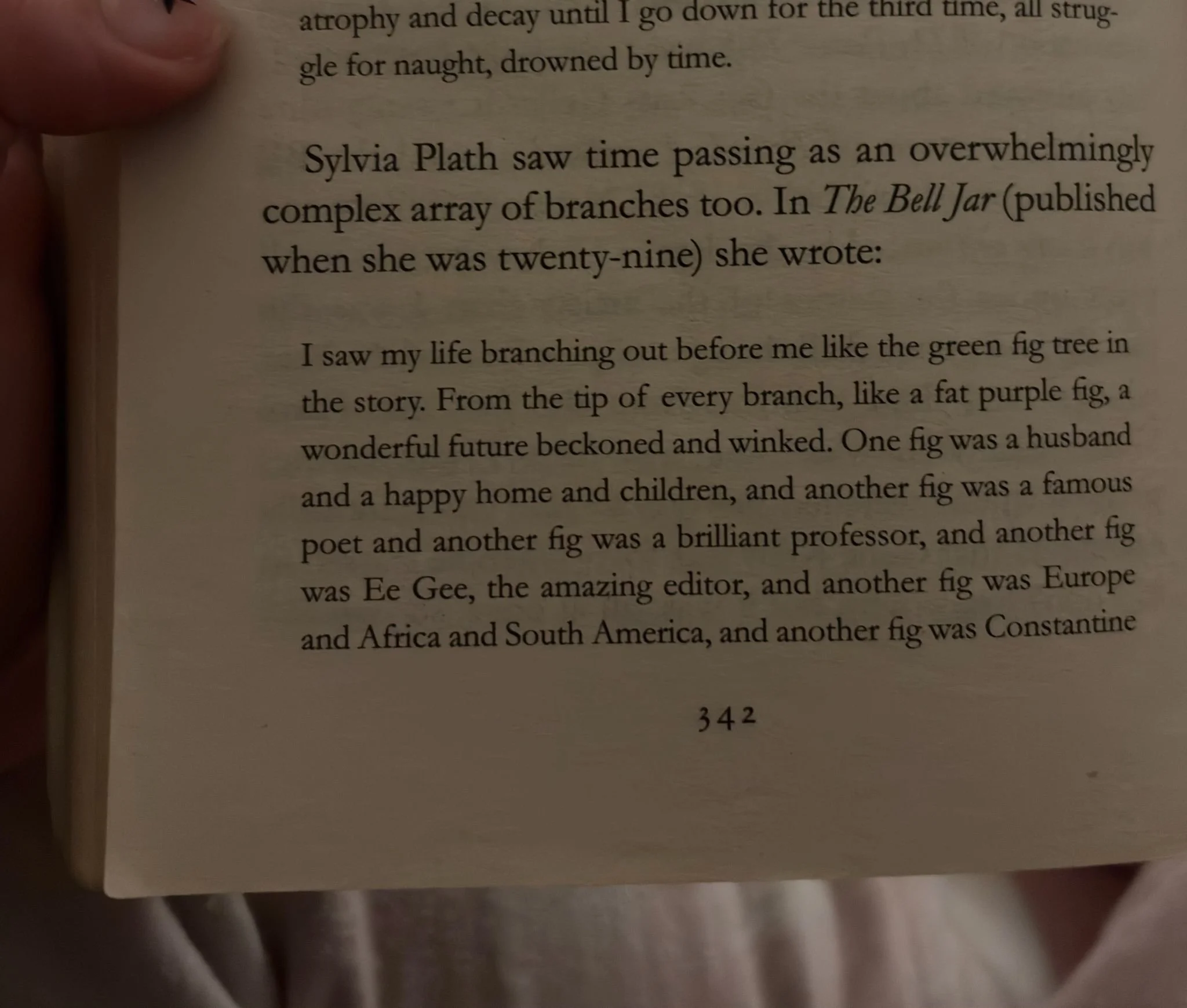
Page from Dolly Alderton, Everything I Know About Love (London: Fig Tree, 2018), 342. Image source: Dorothea Kanellopoulou.
What Plath drew, without naming it, is the fear of wasted potential. The lives we never live. The page offers the abundance and leaves out the starvation — but the abundance is what we recognise. Everyone knows the feeling of too many ripe options. Almost nobody needs to be told about the rot. So the image follows us, not just in literature but in life, and we keep it near us because it names the thing we cannot name ourselves.
I have started to suspect that Plath's fig tree is a pre-digital image of FOMO: a branching display of ripe options, all visible, none graspable.[5] We are paralysed by the fear of missing our own lives. And still, the image serves as comfort. There is a constant fear that I might spend myself on the wrong thing. The selves I will not get to be. I cannot pick them all. Perhaps that has to be enough. Whatever I choose, I can learn to want it. But a tree that never moves is also a tree that never leaves, and I have not decided which of us is doing it right.
References
[1] Plath, Sylvia. The Bell Jar. New York: Harper Perennial, 2005.
[2] St John, Emma. "Why Sylvia Plath's Fig Tree Analogy Isn't as Overwhelming as It First Seems." The Boar. September 9, 2024.
[3] Murray, Sophie. "Fig Trees and the Paradox of Choice." Inspire the Mind. April 7, 2026.
[4] Alderton, Dolly. Everything I Know About Love. London: Fig Tree, 2018.
[5] Amira. "The Fig Tree Analogy: The Lives We'll Never Live." Love Letters to Literature (Substack). November 25, 2025.