
The Artistry of a Funeral: The King Is Dead; Long Live the Image!
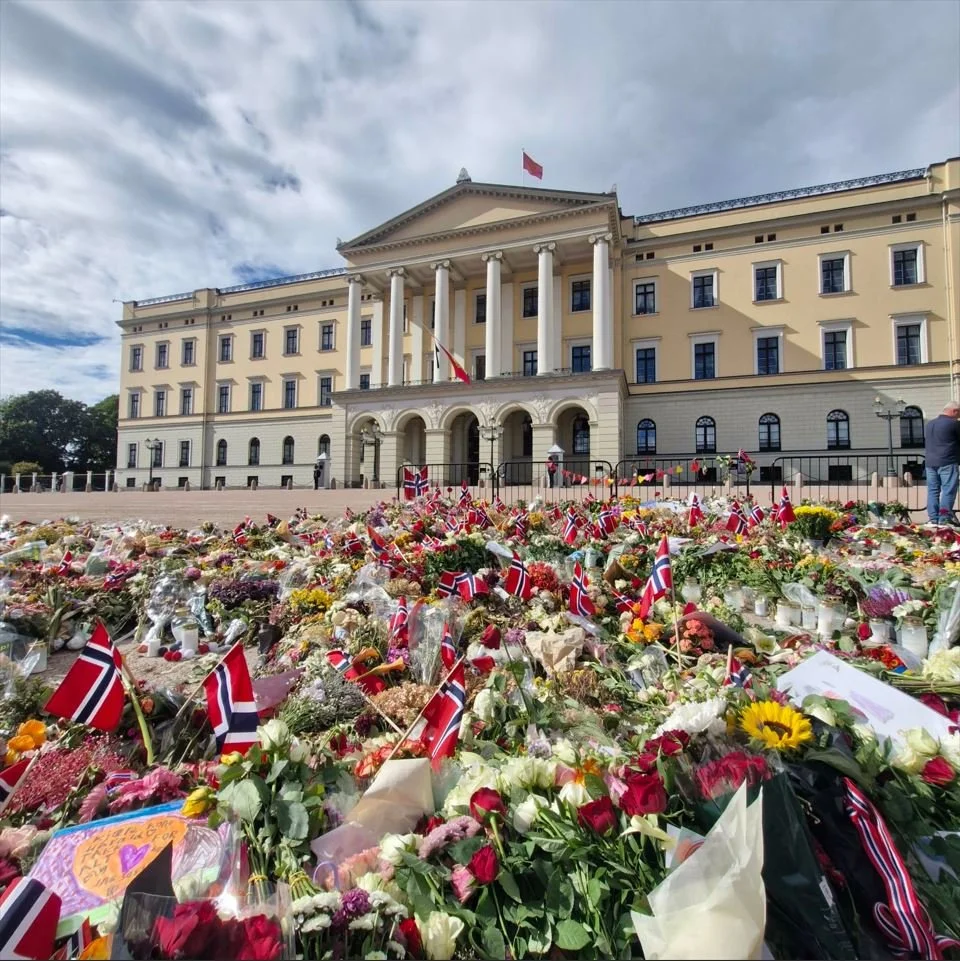
Author. Blomsterhav forran det Kongelige Slott, Oslo. 2026.
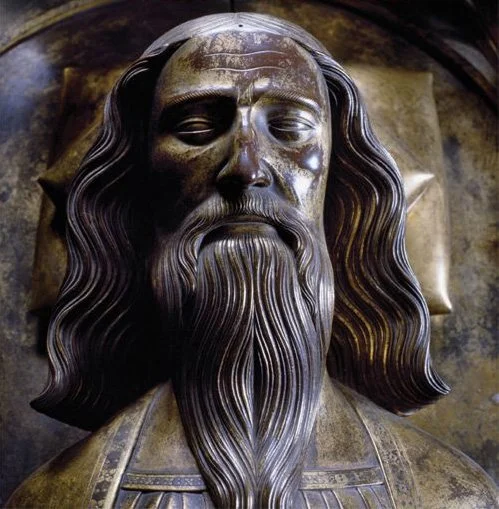
Edward III of England, Detail from His Bronze Effigy in Westminster Abbey. 2012. Photograph. Anonymous photographer.
On August 28 Norway lost its king, and in the days before his funeral on September 9 a certain silence fell over the capital; yet with it came a stirring of the mind toward the days that had been his, in remembrance, fondness, and thanks for a life given to something greater than himself (Det Norske Kongehus 2026a) [1]. There is something almost contradictory in the beauty of a royal funeral: death is private, leveling, and terribly ordinary; yet around the death of a king there gathers gold, music, architecture, heraldry, military dress, bells, flowers, and the movement of thousands—not as isolated embellishments, but as parts of a single ceremonial composition. For a few hours the city itself becomes the medium: the streets its canvas, the uniforms its color, the music its atmosphere, and the crowd both audience and material.
Art has long performed this difficult service for kings. From the late Middle Ages, royal funerals could employ life-sized effigies carried above the coffin, dressed in coronation regalia as though the sovereign still appeared before his people; Edward III’s surviving effigy even preserves a face modeled from a death mask (Westminster Abbey n.d.) [2]. Later, the body might recede behind crown, cushion, standard, and drapery. In the early modern period the impulse expanded into the castrum doloris, temporary architecture raised around princely coffins, where columns, candles, heraldry, allegory, and black cloth transformed mourning into a designed environment (Krass 2023, 311–342) [3]. Funerary art answered a peculiar problem: how does one represent someone precisely when he is no longer there? Tomb sculpture fixed the sovereign in stone or bronze; the effigy gave him, briefly, another body; portraiture preserved the face; heraldry preserved the office.
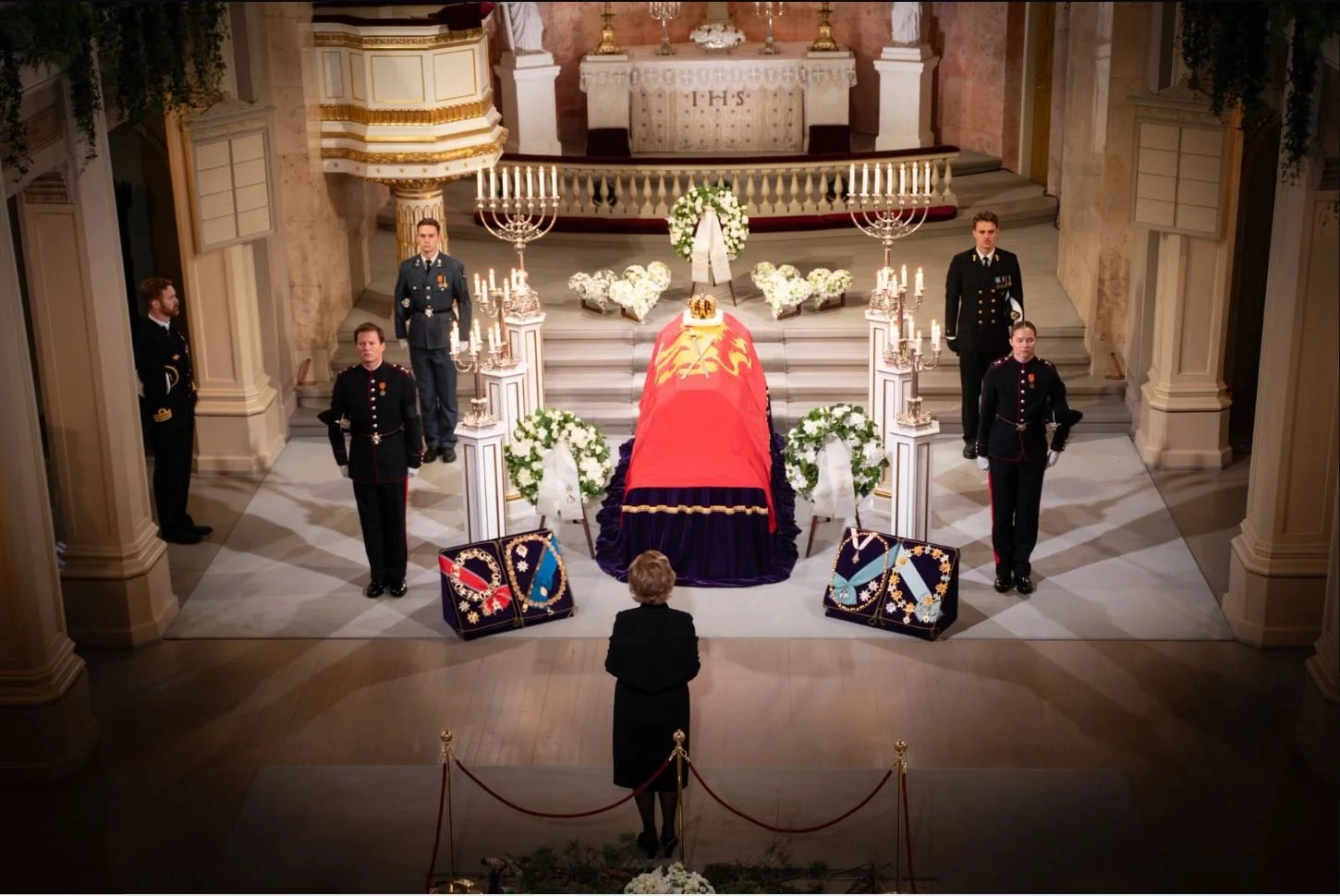
Ask, Anette. 2026. Dronning Sonja i Slottskapellet 7. september. Photograph. Det kongelige hoff.
I felt something of this while passing Harald V’s coffin in the Royal Chapel. I had seen the King innumerable times before, though usually as most subjects know a sovereign: as an image. The face had become familiar long before the person ever could; yet before the coffin there was no face to return the gaze. The flowers, guards, drapery, and ordered stillness gave form to that absence without disguising it (Det Norske Kongehus 2026b) [4]. The procession performed the same work on a larger scale. It turned streets into ceremonial architecture and people into composition: ranks, intervals, colors, repeated forms, the coffin as the still center around which everything else acquired meaning. European courts had long understood procession in this visual sense. Royal entries, triumphs, funerals, and civic festivals transformed streets into temporary theaters of power and memory; banners, liveries, prescribed routes, and ordered bodies made the city itself part of the image (Mulryne et al. 2015) [5]. Such spectacles were ephemeral, but not therefore artistically slight. Their disappearance was part of their force.
A king dies twice and does not die at all. There is first the man: husband, father, and grandfather, whose chair will remain empty (if only for a while) and whose familiar voice belongs suddenly to recordings. Yet beside him exists another body, stranger and less mortal: the Crown, assembled from office, symbol, memory, and expectation. At a royal funeral the two become briefly visible together. Before us lies a king now gone; behind his coffin walks the living monarchy.
I had earlier attended the mourning service in Nidaros Cathedral, where the stone, the liturgy, the royal memory, and the centuries of rebuilding placed the present loss within a history older than the reign itself; then I bowed before Harald’s coffin; finally, I followed the funeral through Oslo. I had been present at each stage, yet never quite there in the intimate sense. Nor had most of us. When the new King appeared upon the Palace balcony later that afternoon, the visual grammar changed at once. The horizontal movement of the procession—coffin, route, following crowd—gave way to the old vertical image of monarchy: sovereign above, people below, palace façade framing the encounter. We had accompanied one king toward burial and, before the day was over, raised our hands toward another (Det Norske Kongehus 2026c) [6]. Whatever one thinks of monarchy, its visual language had made continuity almost unnervingly plain.
For all the language and artistry of Majesty that surrounded Harald in death, another title followed the coffin too, though no herald announced it and no order of precedence could assign it a place: hele Norges bestefar—all Norway’s grandfather. The phrase explains something the pomp might otherwise obscure or lose. Norway had not gathered merely to witness the burial of a king. A great many people had come to say goodbye to Harald the man and grandfather. Perhaps that is why the old art of royal death still possesses power: not merely because it magnifies authority, but also because it attempts something more human and more impossible—to give shape to loss, continuity to memory, and visible order to the disorder left when a familiar life has ended.
Litteraturliste
[1] Det Norske Kongehus. 2026a. “Kong Harald stedt til hvile.” September 9, 2026.
https://www.kongehuset.no/nyheter/kong-harald-v-stedt-til-hvile
[2] Det Norske Kongehus. 2026b. “Kong Haralds båre til Slottskapellet.” August 30, 2026.
https://www.kongehuset.no/presse/pressemeldinger/kong-haralds-bare-til-
[3] Det Norske Kongehus. 2026c. “Kongefamilien på Slottsbalkongen.” September 8, 2026.
https://www.kongehuset.no/presse/pressemeldinger/kongefamilien-pa-slottsbalkongen
[4] Krass, Urte. 2023. “The Funeral Apparatus of John IV (November 1656).” In The Portuguese
Restoration of 1640 and Its Global Visualization: Political Iconography and
Transcultural Negotiation. Amsterdam University Press. https://doi.org/10.1515/9789048551750-011
[5] Mulryne, J. R., Maria Ines Aliverti, and Anna Maria Testaverde, eds. 2015. Ceremonial
Entries in Early Modern Europe: The Iconography of Power. Ashgate.
[6] Westminster Abbey. n.d. “Edward III and Philippa of Hainault.” Accessed September
16, 2026. https://www.westminster-abbey.org/abbey-commemorations/royals/edward-iii-and-philippa-of-hainault
Illustrasjoner
Author. Blomsterhav forran det Kongelige Slott, Oslo. 2026.
Ask, Anette. 2026. Dronning Sonja i Slottskapellet 7. september. Photograph. Det kongelige
hoff. https://www.kongehuset.no/for-pressen/foto-for-pressen
Edward III of England, Detail from His Bronze Effigy in Westminster Abbey. 2012.
Photograph. Anonymous photographer. https://commons.wikimedia.org/wiki/File:Edward-III-king-England.jpg
